How to Teach Blending: From Separate Sounds to Whole Words
Blending is the skill of joining separate sounds into a word: /s/ /a/ /t/ becomes sat. It is the bridge between knowing letter sounds and actually reading, and it is the step where many beginning readers get stuck. This guide shows a simple, step-by-step way to teach it and what to try when "my child can't blend sounds."
The core routine: tap, slide, say
The routine in The Decodable Readers Library's Parent Guide has three moves.
- Tap. Tap a finger under each letter or sound while saying it: /k/ /a/ /t/.
- Slide. Say the sounds again, closer together and faster, sliding from one to the next: /kaaat/.
- Say. Say the word at normal speed: "cat".
On the warm-up page of every story, each word has a dot under every sound. A line under two or three letters means they work as a team and make one sound, like sh or ai. The dots tell the child where to tap, so they never have to decide where the sounds split.
Teaching blending in steps
Go up the ladder one rung at a time. Move on only when the child is comfortable.
Step 1: Hear the sounds
Before blending text, check that your child can blend by ear. Say the sounds slowly and ask them to say the word: "/m/ ... /a/ ... /p/. What word?" Start with sounds you say, and no letters at all.
Step 2: Use two-sound words
Begin with words like am, at, in and up. Two sounds are much easier to hold in mind than three.
Step 3: Move to three-sound words
Next come simple consonant-vowel-consonant words: sat, mop, pig. Start with words that begin with a sound you can hold: /m/, /s/, /f/, /n/, /l/, /r/. Sounds that stop sharply, such as /t/, /p/ and /b/, are harder to start a word with.
Step 4: Keep the sounds clean
Say /t/ and not "tuh". Say /m/ held and not "muh". Clean sounds blend into real words, while extra vowels get in the way.
Step 5: Read the word in a sentence
Once a word is blended, put it to work. A one-line sentence such as Sam sat. shows the child that blending leads somewhere.
What to do when your child can't blend
If sounds come out fine but the word never appears, the problem is usually not a lack of effort. Try these adjustments one at a time.
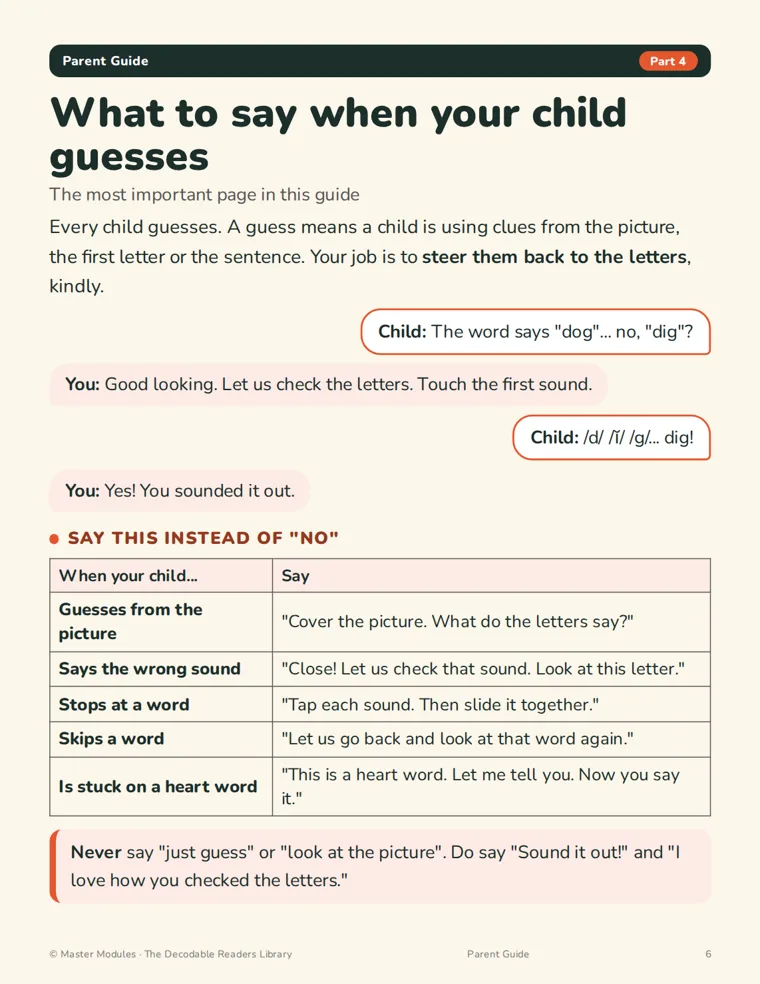
| What you notice | Try this |
|---|---|
| Says each sound but cannot join them | Slow down, then speed up. Say it for them once, then have them copy you. |
| Forgets the first sound by the end | Use two-sound words or move a finger along the letters as you blend. |
| Adds a vowel to each sound ("tuh-ah-tuh") | Model short, clean sounds. Practice the single sounds alone for a day. |
| Guesses a word from the first letter | "Cover the picture. Let's tap and slide all the sounds." |
| Gets frustrated | Stop. Go back to an easier step, end on a win and try again tomorrow. |
| Cannot blend by ear without letters | Spend a few days on spoken blending games before returning to print. |
Why can my child not blend words?
There are common, ordinary reasons. The letter sounds may not yet be automatic, so the child is spending effort remembering sounds, not joining them. The sounds may be pronounced with extra vowels. The words may be too long for now. Or the child may simply need more time. Most of these are fixable by making the step smaller.
Blending games for a few minutes a day
- Robot talk. You say the word in robot sounds, /s/ /u/ /n/. The child says the word.
- Stretch it. Say a word slowly like a rubber band and let the child say it back.
- Sound hunt. Tap and slide the words on a list, then toss a die and read that row.
- Build it. Use letter tiles to make sat, then change one tile to make sit.
A worked example
Take the first story in Stage 1 of the library. It reads: Sam sat. Pip sat. Sam has a hat. Pip hid in the hat. The hat ran! The warm-up page shows Sam, sat, hat, ran, cat, bag and hid with dots under each sound. The child taps and slides each word once, reads the tricky words the, a, and and has, and then reads the story.
Because every word in the story can be sounded out, the blending the child just practiced is exactly what the story needs.
Where The Decodable Readers Library fits
Stage 1 contains 12 stories that use short a and short i with a small set of consonants, so the first things a child blends are the simplest words. Stage 1 also has 8 activity centers: picture word cards, word building, clip cards, roll and read, tracing, sentence scramble, read and match and a reward chart. Many of these are blending practice in game form.
The 3-Minute Placement Test shows whether your child should begin at Stage 1 or further on. The Parent Guide includes the tap, slide, say routine and example conversations.
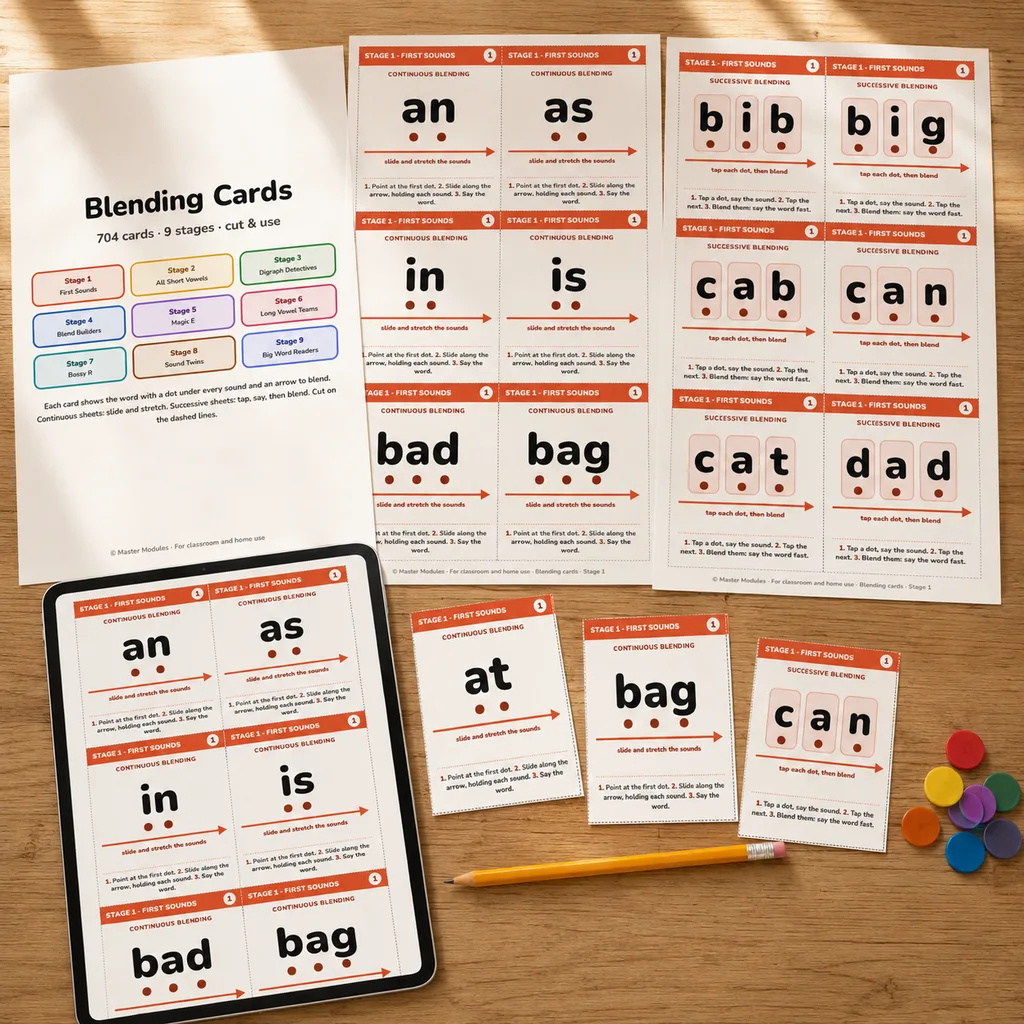
If you want extra hands-on practice, the library also has an optional add-on of 650+ Blending and Segmenting Cards with a guide and practice sheets. It is sold separately and is not part of the main library.
For more, read about printable blending cards, see short vowel stories for the first books to try, learn about the phonics screener and placement test and review what decodable books are.