Phonics Screener and Placement Test: Find Where to Start in 3 Minutes
A phonics screener is a short check that shows which letter patterns a child can read, so teaching can start at the right level. The idea is simple: give the child lists of words, one list for each stage of a phonics order, and score how many they read correctly. The first list they struggle with tells you where to begin. Done well, it takes about three minutes.
Why use a screener instead of guessing
Starting too low wastes weeks and bores a child. Starting too high leads to guessing and frustration. Age and grade are weak guides, because children of the same age can be several stages apart. A short, direct check of word reading gives a better answer.
How the test works
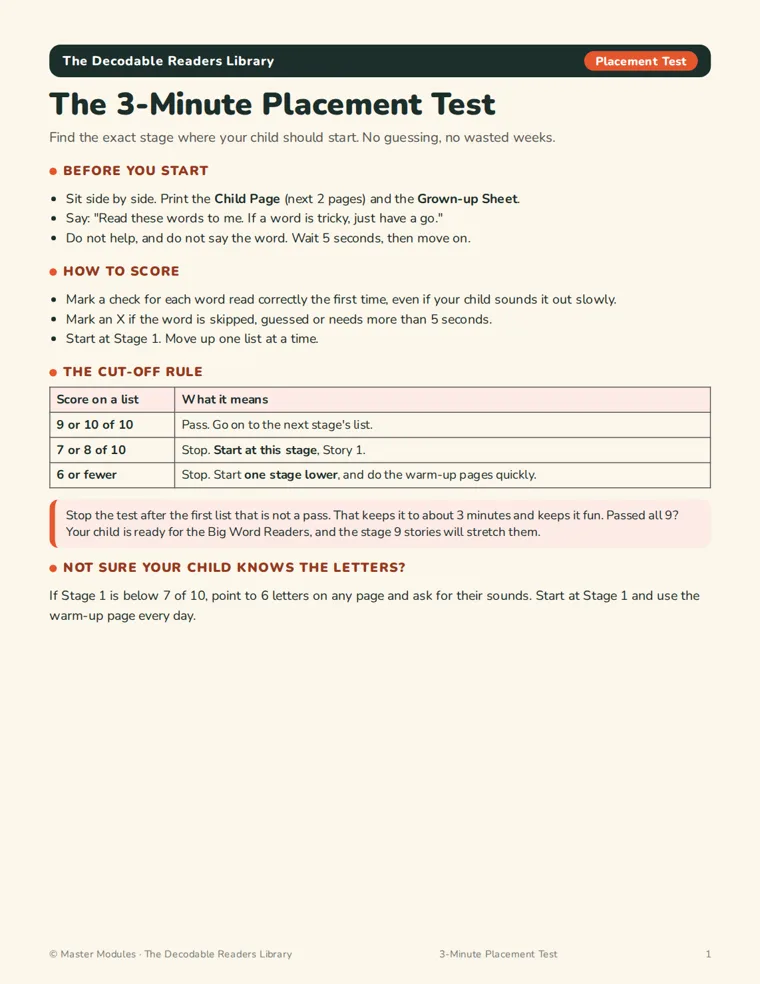
The 3-Minute Placement Test in The Decodable Readers Library has one list of 10 words for each of the 9 stages. The words for each stage come from the stories of that stage, so a word list for Stage 3 uses the patterns taught in Stage 3.
Before you start
- Sit side by side. Print the child pages and the grown-up sheet.
- Say: "Read these words to me. If a word is tricky, just have a go."
- Do not help and do not say the word. Wait about five seconds, then move on.
How to score
- Mark a check for each word read correctly the first time, even if the child sounds it out slowly.
- Mark an X if a word is skipped, guessed or takes more than five seconds.
- Start with the Stage 1 list and move up one list at a time.
The cut-off rule
| Score on a list | What it means |
|---|---|
| 9 or 10 of 10 | Pass. Go on to the next stage's list. |
| 7 or 8 of 10 | Stop. Start at this stage, Story 1. |
| 6 or fewer | Stop. Start one stage lower, and do the warm-up pages quickly. |
Stop at the first list that is not a pass. That keeps the test short and keeps it positive. If a child passes all nine, they are ready to start at Stage 9, Big Word Readers, where the stories will stretch them.
The nine lists at a glance
| Stage | Name | What the word list checks |
|---|---|---|
| 1 | First Sounds | Short a and i words with first consonants |
| 2 | All Short Vowels | Short o, u, e and the rest of the alphabet |
| 3 | Digraph Detectives | sh, ch, th, wh, ck, ng, nk and doubled letters |
| 4 | Blend Builders | Beginning and ending blends |
| 5 | Magic E | Silent e, -tch and -dge |
| 6 | Long Vowel Teams | ai, ay, ee, ea, oa, ow, igh and more |
| 7 | Bossy R | ar, or, ore, er, ir, ur |
| 8 | Sound Twins | oo, ou, oi, oy, au, aw, ew, ue |
| 9 | Big Word Readers | Endings, compound words and two-syllable words |
What if my child does not know the letters?
If a child scores below 7 on the Stage 1 list, check the letters directly. Point to six letters on any page and ask for their sounds. Then begin at Stage 1 and do the warm-up page every day. Do not push on to word lists until a few sounds are secure.
Tips for a calm, accurate test
- Pick a good moment. Not after a long day or right before a meal.
- Keep it light. Present it as a game of reading words.
- Do not hint. Helping gives a score that is too high and a starting point that is too hard.
- Count first tries. A self-correction after a wrong guess does not count.
- Note the type of error. Sounds missed, guessed from the first letter or stopped altogether tell you what to practice.
What a screener does not do
A home placement test is a teaching aid, not a diagnosis. It picks a starting point. It does not test for reading difficulties, and it should not be used to label a child. If you have a concern about how your child is learning to read, talk to their teacher or a qualified professional.
After the test
- Write down the start. The grown-up sheet has a line for the stage and story number to begin at, and a date to re-test in six to eight weeks.
- Begin at Story 1 of the stage. Read the Parent Guide pages for that stage first.
- Use the warm-up page every time. It covers the new sounds, tap-and-slide words, tricky words and a speed read.
- Move on at the child's pace. If a story is read accurately on the second read, go to the next one.
- Re-test. Every six to eight weeks, or sooner if a stage feels too easy.
The test is also available in the library's members web app, which also tracks progress, so you can run it on a device when that is easier than paper.
Choosing a screener
If you are comparing options, look for these features.
- Word lists tied to a stated order of letter patterns.
- A clear rule for passing and stopping.
- A way to turn the result into a place to start, not just a score.
- A reasonable length for a young child.
For the order the lists follow, see the phonics scope and sequence. For where kindergarteners often land, see decodable books for kindergarten. If you are teaching at home, a daily homeschool phonics routine shows how to use the result, and how to teach blending helps when a child cannot blend yet.