Short Vowel Stories: What Stages 1 and 2 Teach and How to Read Them
Short vowel stories are where reading starts. A short vowel in a simple consonant-vowel-consonant word, like cat, pig or mud, is the easiest pattern to sound out. In The Decodable Readers Library, Stages 1 and 2 are made of these stories: 24 of the 108 in the set. This guide shows what is in them and how to read them with a child.
Stage 1: short a and short i
Stage 1, First Sounds, teaches short a and short i with 15 consonants: m, s, t, p, n, c, f, d, g, h, b, r and l. Tricky words are the, a, I, is, to, and, his, has. Pages hold up to 12 words.
The twelve stories
| # | Title | Focus |
|---|---|---|
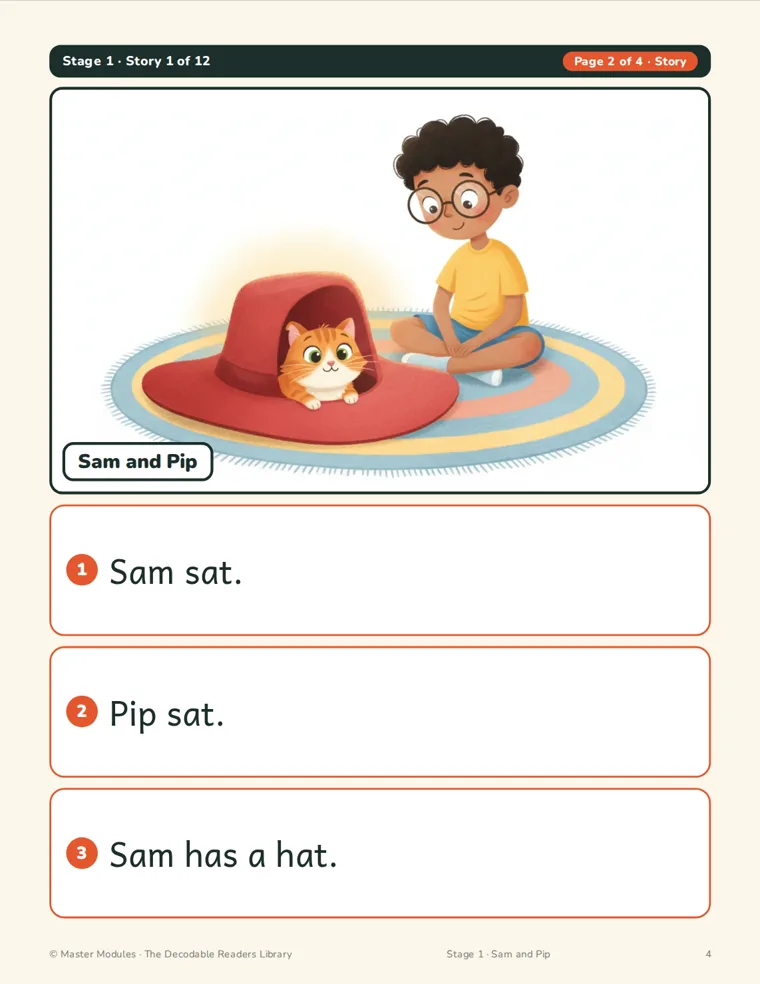
| 1 | Sam and Pip | short a |
| 2 | The Fat Cat | short a, -at words |
| 3 | A Nap | short a, -ap words |
| 4 | The Big Pig | short i, -ig words |
| 5 | Sip, Sip, Sip | short i, -ip words |
| 6 | Sam Has a Bag | short a, -ag words |
| 7 | Sit, Pip! | short i, -it words |
| 8 | A Hat and a Cap | short a and short i |
| 9 | Sam and the Hill | double l, -ill words |
| 10 | Hiss! | double s |
| 11 | The Fan | short a, -an words |
| 12 | The Big Dig | review of a and i |
Each story works on a word family, so children see the same ending again and again. The Fat Cat reads: Pip is a fat cat. Pip has a nap. Sam can tap Pip. Pip is mad. Pip ran at a rat. The last page: Pip and the rat sat. A nap!
The Big Pig is even shorter per page: A pig! A big pig! Sam hid. Pip hid. The pig did dig. Dig, dig, dig! A big pit!
Stage 2: short o, u and e
Stage 2, All Short Vowels, adds short o, u and e, finishes the alphabet with k, j, v, w, x, y and z and introduces qu and plural s. Pages hold up to 16 words. Fourteen tricky words come in: of, was, you, he, she, we, me, be, said, are, do, no, go, so.
The twelve stories
| # | Title | Focus |
|---|---|---|
| 1 | Max the Dog | short o |
| 2 | Hop on the Log | short o |
| 3 | Mud Fun | short u |
| 4 | The Bug on the Rug | short u |
| 5 | Ten Hens | short e |
| 6 | Max Gets a Vet | short e |
| 7 | The Fox in the Box | x says ks, j, v |
| 8 | Quit It, Max! | qu says kw |
| 9 | Zip and Buzz | z, zz |
| 10 | Wag, Wag, Wag | w, y |
| 11 | Hugs, Hugs, Hugs | plural s |
| 12 | Mix It Up | review |
A sample from Max the Dog: Max is a big dog. Max can hop. Hop, hop, hop! Kit has a mop. Max got the mop! And from Mud Fun: The sun is up. Max can run. Max ran to the mud. Max sat in the mud! Mud, mud, mud! Max had fun!
What a short vowel lesson looks like
- Warm-up. Page 1 shows the story's words with a dot under each sound. The child taps and slides each one: /k/ /a/ /t/, "cat".
- Tricky words. The heart words appear in heart-shaped boxes.
- Speed read. The child reads the list three times, coloring a star each time.
- Read the story. Pages 2 and 3, twice.
- Activities. Three questions, a word hunt, a sentence to write and a space to draw.
The parent tip on each story helps the adult. For short o, it says: "Short o says /o/ as in dog. Make the mouth round and open." For short u: "Short u says /u/ as in sun. Ask your child to say uh." For short i: "Stretch the sound: p-i-i-g."
Teaching short vowels well
- Keep sounds clean. Say /t/, not "tuh".
- Stretch the vowel. Hold the middle sound a little: p-i-i-g.
- Use word families. Once a child reads cat, fat and sat, change the first letter to make a new word.
- Contrast similar vowels. Short i and e are easily confused; practice pairs such as pin and pen.
- Read twice. First for accuracy, then for smoothness.
- Cover the picture if the child keeps looking at it.
When the child is stuck
| What you see | What to try |
|---|---|
| Says each sound but cannot join them | Slide the sounds closer and have them copy you |
| Guesses from the first letter | "Cover the picture. Tap each sound." |
| Mixes up b and d | Pair each with a picture clue and practice one at a time |
| Forgets the tricky words | Do the one-minute heart word routine, then re-read |
| Gets frustrated | Go back one story, shorten the session, end on a win |
The Parent Guide in the library covers these moments in detail, with scripts for what to say.
Practice beyond the stories
Each of the two stages has 8 activity centers: picture word cards, word building, clip cards, roll and read, tracing, sentence scramble, read and match and a reward chart. For example, in word building, a child builds dog with letter tiles and then writes it.
An optional add-on of blending and segmenting cards offers extra hands-on practice, sold separately.
Where these stages lead
Once a child reads Stage 2 smoothly, Stage 3 adds digraphs (sh, ch, th, wh, ck, ng, nk), then blends in Stage 4 and silent e in Stage 5.
To go deeper, read how to teach blending, decodable books for kindergarten, silent e stories for Stage 5 and printable blending cards for extra practice.