What Are Decodable Books and How Do You Tell If a Book Is Decodable?
A decodable book is a book a child can read by sounding out every word, because it only uses the letter-sound patterns the child has already been taught. That is the whole idea. A child who has learned the sounds for s, a, t, p, i and n can read "Sit, Pip!" without guessing, because every word is built from those sounds. A child who has not learned them cannot, and the book would not be decodable for that child.
The word to hold on to is for. A book is decodable for a child at a given point, not in the abstract. The same story that is decodable for a child on their third stage is not decodable for a child on their first.
What makes a text decodable
Three things have to be true together.
- The words follow taught patterns. Each word can be broken into letter groups the child has learned, such as s-a-t or sh-i-p.
- The tricky words are few and pre-taught. English has common words that do not follow the usual patterns, such as the, was and said. A decodable text uses only the ones the child has already been taught as whole words.
- The order is cumulative. Each new book can use everything from earlier books, plus a small new set of patterns. Nothing appears that has not been taught.
When those three hold, a child can succeed on every word using the strategy you want them to build: look at the letters, say the sounds, blend them.
What a decodable text allows a child to do
The point is not that decodable books are easy. The point is that they make one particular strategy work every time.
- Rely on the letters. The word on the page can be read from the letters alone. Pictures, context and guessing from the first letter are not needed.
- Get immediate proof that sounding out works. A child who sounds out dig and gets dig learns that the system is reliable.
- Practice a pattern in a real sentence. Words like hid, hat and ran are repeated in a story, not just a list.
- Build fluency step by step. Rereading a short text a few times moves a child from slow, careful decoding toward smoother reading.
How to check a book yourself
You do not need special training to test a book. Use this quick check.
- List what your child knows. Write down the letter sounds and letter teams they can read reliably and the tricky words they know.
- Read the whole book yourself. Go slowly and stop at any word that needs something outside your list.
- Count the exceptions. One or two untaught words in a page is a sign the book was written for general reading, not for decoding.
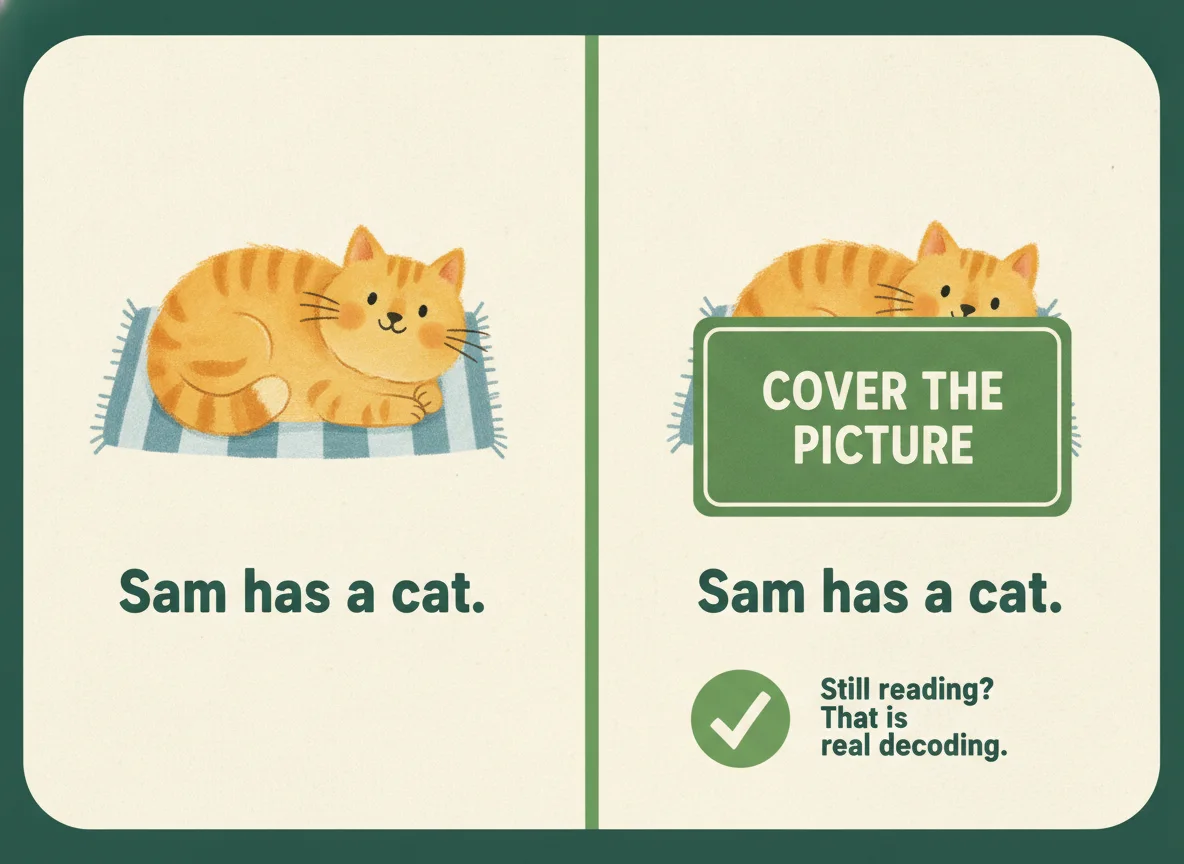
- Check the pictures. If you could cover the words and still follow the story from the images alone, the pictures are doing work the words should do.
| What you see | What it means |
|---|---|
| Every word fits what the child has learned | Decodable for this child now |
| One or two words are new, and you can say them first | Usable with support, but not a clean decodable read |
| Many words need patterns the child has not met | Not decodable for this child yet |
| The same sentence repeats and the pictures give the answer | A predictable book, which is a different tool |
Decodable is not the same as simple
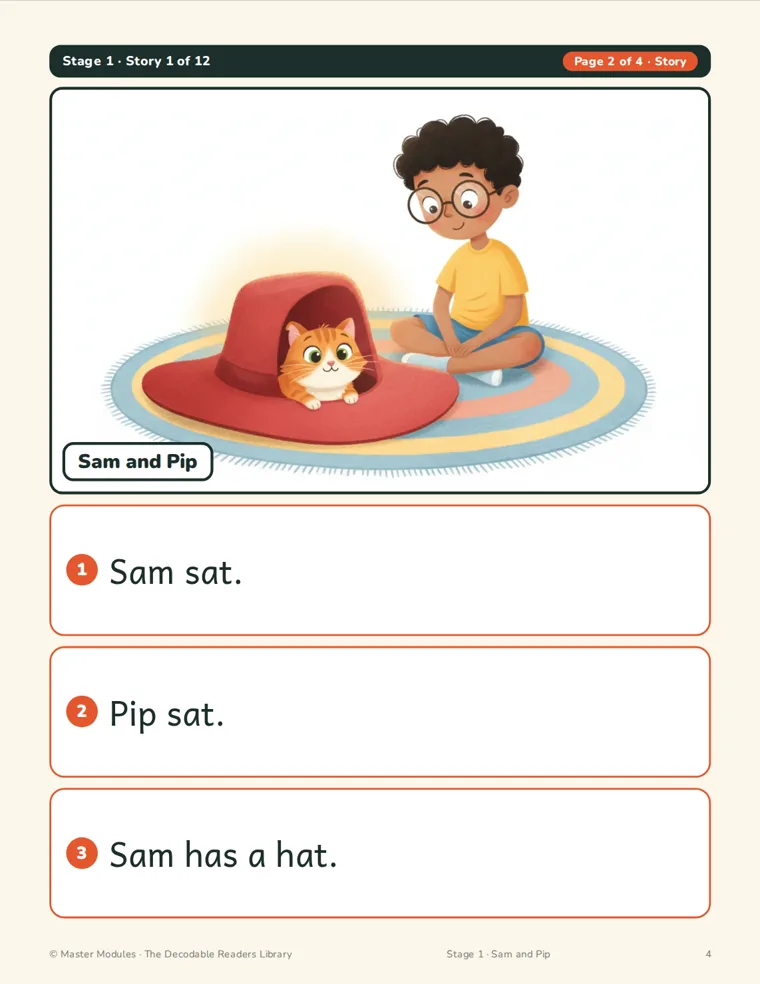
A decodable story can have a plot, characters and a joke. What it cannot do is use a word the child has not been equipped to read. At the earliest stages, that means very short sentences: Sam sat. Pip sat. Sam has a hat. Pip hid in the hat. The hat ran! Notice that this is a small story with a twist, written using only short a, short i, a few consonants and the tricky words the, a, and and has that the stage teaches.
As more patterns are taught, the stories grow. By the later stages a text can use vowel teams, r-controlled vowels and word endings, because those patterns have been taught.
How The Decodable Readers Library handles this
The Decodable Readers Library is built around exactly this definition. It has 9 stages with 12 stories each, 108 stories in all, and each stage teaches a defined set of new letter patterns and tricky words. The tricky words are cumulative, so Stage 1 uses the, a, I, is, to, and, his, has, and later stages add more.
Every story is checked by a script against the patterns taught up to its stage, so a word that needs something untaught is flagged before the story is included. That check is what makes "decodable" a property you can test, not a label.
The stories get longer as the stages move up: the page limit is 12 words on a Stage 1 page, rising stage by stage to 48 words on a Stage 9 page. Each story has six pages and comes in color and black and white.
Each story also comes with a four-page lesson packet. Page 1 is a warm-up of the new sounds, tap-and-slide words, tricky words and a speed read. Pages 2 and 3 are the story itself. Page 4 has comprehension questions, a word hunt, a sentence to write and a space to draw. Alongside the stories you get a 3-Minute Placement Test to find the right starting stage, a Parent Guide that says what to say on every page, 8 activity centers for each stage, a progress tracker and a certificate for each stage.
When a decodable book is the right tool
Decodable books suit a child who is learning to read and needs practice applying phonics to connected text. They are less useful for reading aloud for pleasure, building vocabulary or sharing rich picture books, so most families use both. Read the decodable book for your child's reading practice, and read a long, beautiful storybook to them at bedtime.
If you are not sure where your child is on this path, the placement test in the library finds the stage in about three minutes. For the order patterns are taught in, see the scope and sequence guide. To weigh decodable books against levelled series, read decodable vs leveled readers, and for an honest look at the limits, the pros and cons of decodable texts. A full tour of the stages is in decodable readers: the 9 stages.