Printable Blending Cards: How to Use Them, Stage by Stage
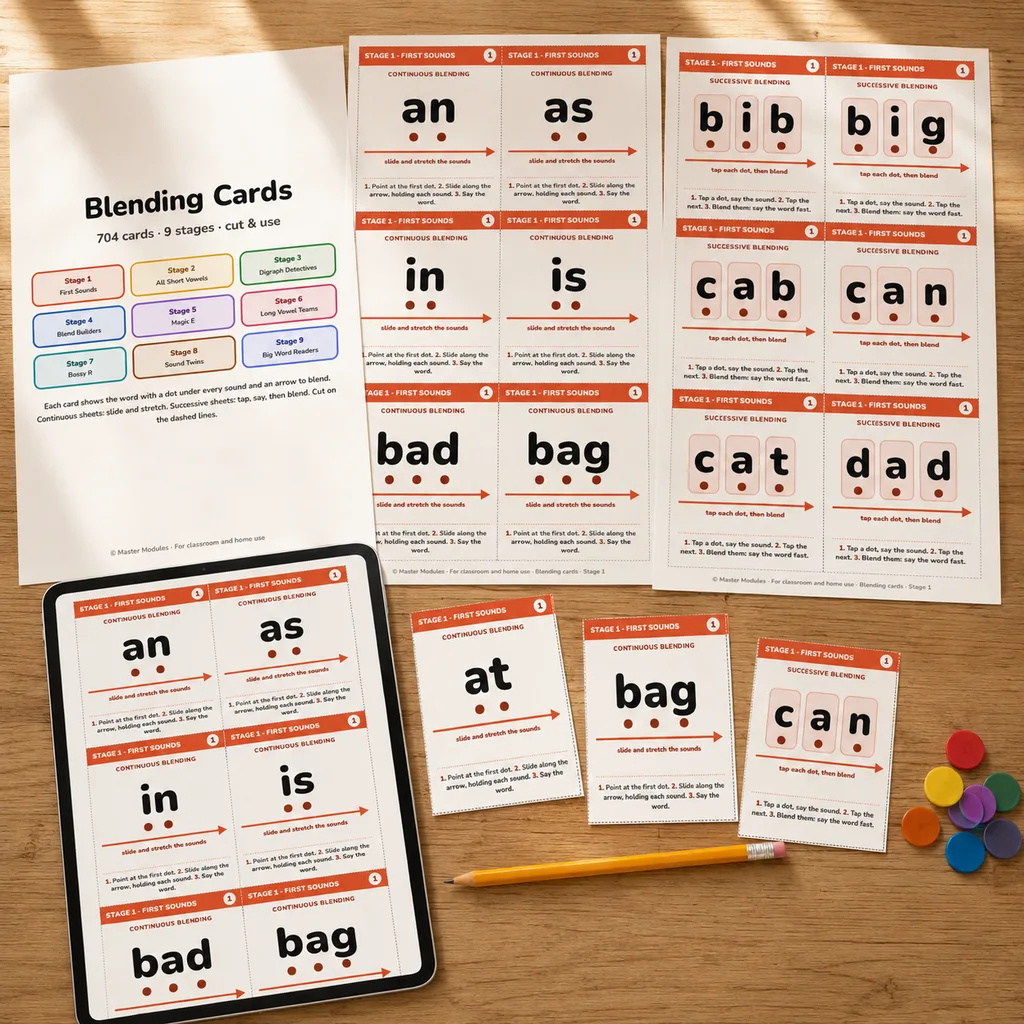
Blending cards give a beginning reader quick, repeatable practice at joining sounds into words. Each card shows a word with its sounds marked, and the child taps and slides to read it. Segmenting cards run the other way, breaking a word into sounds. This guide explains how to use both, how to match them to a child's stage and what the optional card set in The Decodable Readers Library contains.
How a blending card works
A good blending card makes the sounds visible.
- A dot under a letter means one sound.
- A line under two or three letters means they work together as one sound, like sh or ai.
- A grey letter is silent, like the e in cake.
- An arrow shows the direction to slide.
The child follows three steps: tap a finger under each sound, slide the sounds together and say the word at normal speed.
How a segmenting card works
A segmenting card hides the marks and asks the child to find them. Typical uses are:
- The child looks at the word, say ship.
- They push a counter or fill a box for each sound they hear: /sh/ /i/ /p/ is three.
- They count the boxes and say each sound.
- They check the word.
Segmenting is the base of spelling, so a child who does it well is also getting ready to write.
Using cards by stage
Match the cards to the stage the child is working on.
| Stage | Focus | What to practice with cards |
|---|---|---|
| 1 | Short a and i | Simple CVC words: sat, pig, map |
| 2 | Short o, u and e | CVC words with all five short vowels |
| 3 | Digraphs | ship, chin, thin, duck, ring |
| 4 | Blends | frog, stamp, plan, milk |
| 5 | Silent e | cake, kite, hope beside cap, kit, hop |
| 6 | Vowel teams | rain, day, feet, boat |
| 7 | R-controlled vowels | car, corn, bird |
| 8 | Vowel pairs | moon, book, coin, cow |
| 9 | Big words | Endings and two-syllable words |
Ten-minute card games
- Flip and read. Turn over a card, tap, slide and say. Five cards is plenty.
- Beat the pile. Read a small stack of cards, then read it again and try to be smoother.
- Change one sound. Read sat, then change the first sound to make mat.
- Roll and read. Roll a die and read the row of words with that number.
- Sound boxes. Say a word and have the child fill a box for each sound.
- Sort. Put cards with the same pattern in the same pile.
What goes wrong with cards
| Problem | Fix |
|---|---|
| The child reads the card by memory | Mix the order; add new words |
| The child adds "uh" to each sound | Model short, clean sounds: /t/, not "tuh" |
| The words are too hard | Go back one stage |
| The session drags | Stop at five cards and play a game |
| The child guesses | "Cover the picture. Tap each sound." |
What the library does for blending
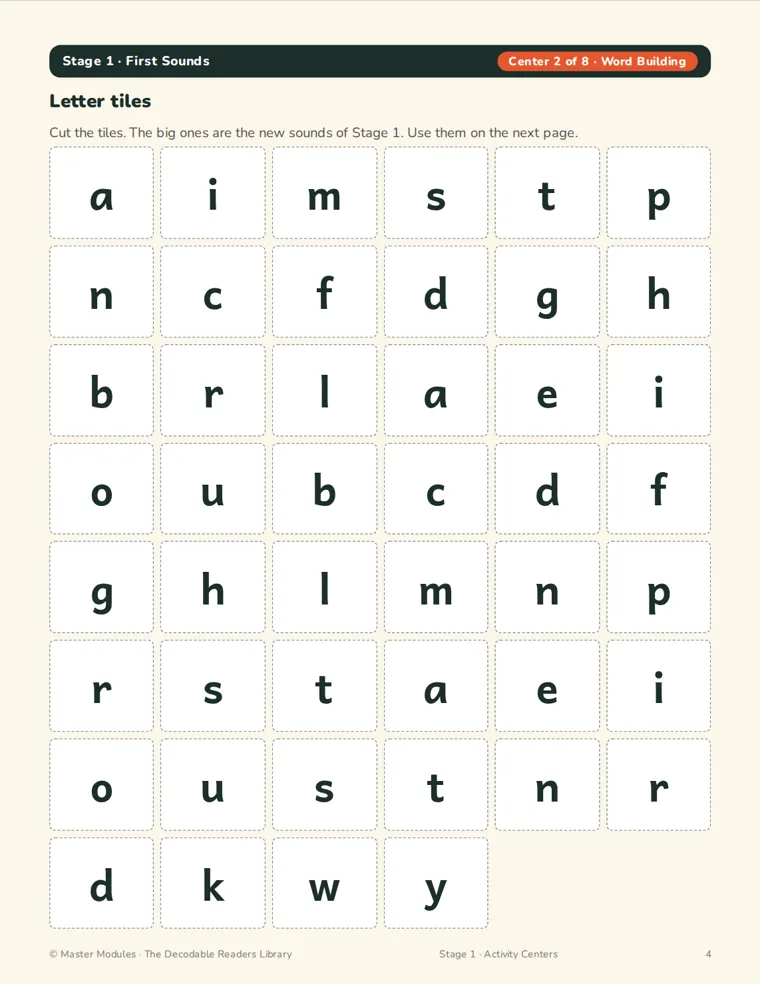
The main Decodable Readers Library teaches blending in the way every lesson is built. The warm-up page of each story shows the story's words with dots and lines under the sounds, so the child taps and slides each one before reading. Each stage also has 8 activity centers, including word building with letter tiles, clip cards, roll and read, and tracing. And the Parent Guide spells out the tap, slide, say routine.
The optional card set
For families who want more hands-on practice, there is an optional add-on: 650+ Blending and Segmenting Cards. It is sold separately and is not included in the main library. It contains:
- A blending guide.
- Blending cards, in color and in black and white.
- Segmenting cards, in color and in black and white.
- Blending and segmenting worksheets, in color and in black and white.
The cards are designed for every stage, so they line up with the stories. You can print them, cut them and keep them in a zip bag.
Printing and storing cards
- Print on card stock if you can; the cards get a lot of handling.
- Print in black and white to save ink, and let your child color them.
- Cut along the dashed lines only.
- Keep each stage's cards in a separate bag or envelope.
- Laminate or use sheet protectors if you want to reuse worksheets with a dry-erase marker.
A simple plan
- Take the placement test to find the stage.
- Read the story's warm-up words with tap, slide, say.
- Play one five-card game after the story.
- Re-read the story the next day.
- Add new cards as new patterns arrive.
For the underlying teaching, read how to teach blending. For the first stories that use this skill, see short vowel stories. For printing tips, see printable decodable books, and to see how the whole set fits together, read decodable readers: the 9 stages.