Phonics Word Lists by Rule: 16 Ready-to-Use Lists
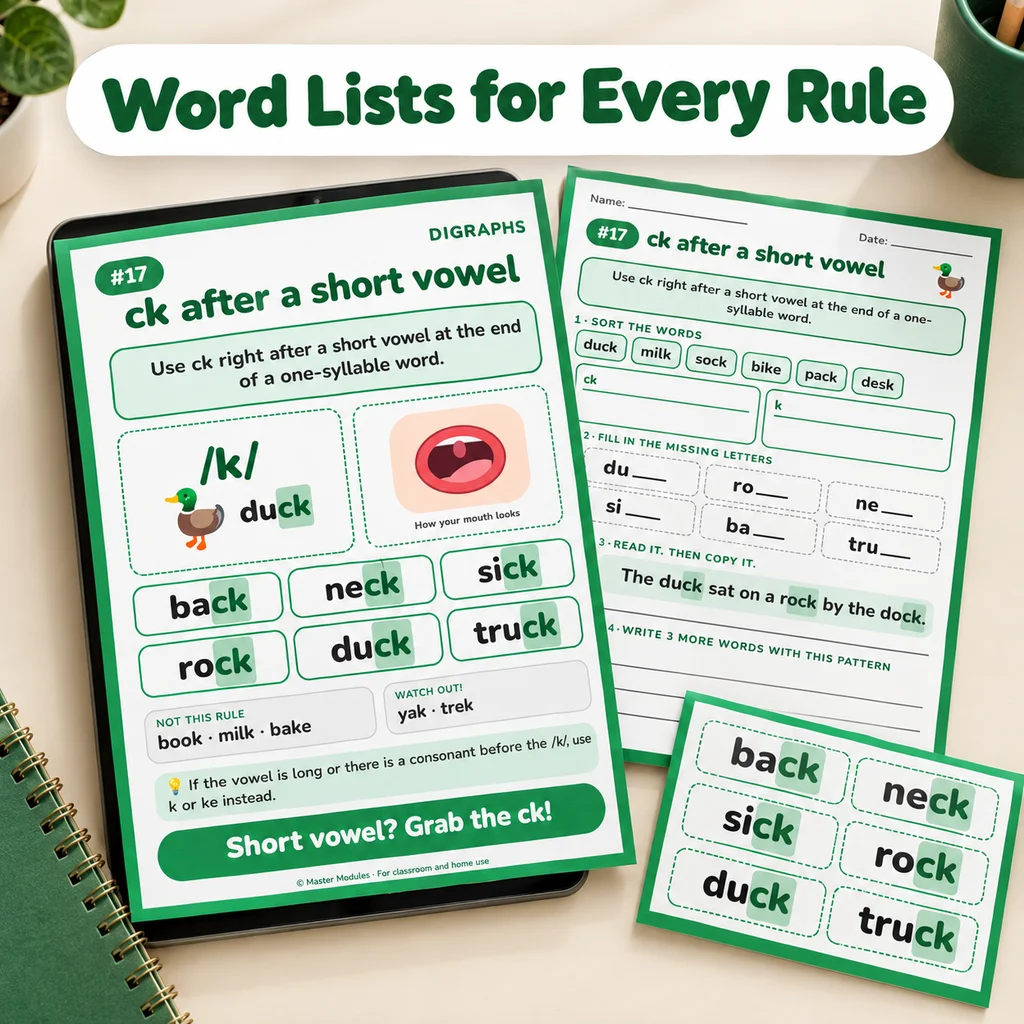
A phonics word list is a set of words that share one spelling pattern, used to practice reading and spelling that pattern. Below are 16 lists, 20 words each, for rules commonly taught in kindergarten through grade 3. Each has the rule in a sentence, so you can teach it and practice it from the same page. Use them for fluency warm-ups, sorts, dictation or homework.
How to use a list
- Teach the rule first. Read the one-sentence rule and say three words.
- Read the list together down the page, then across.
- Sort. Make two piles: words that follow the rule and a few that do not (use the contrast words in the rule).
- Dictate. Say five or six words. Children write them and underline the pattern.
- Use it. Ask for a sentence with two list words.
Keep it short. A list is a tool for one week, not the whole lesson.
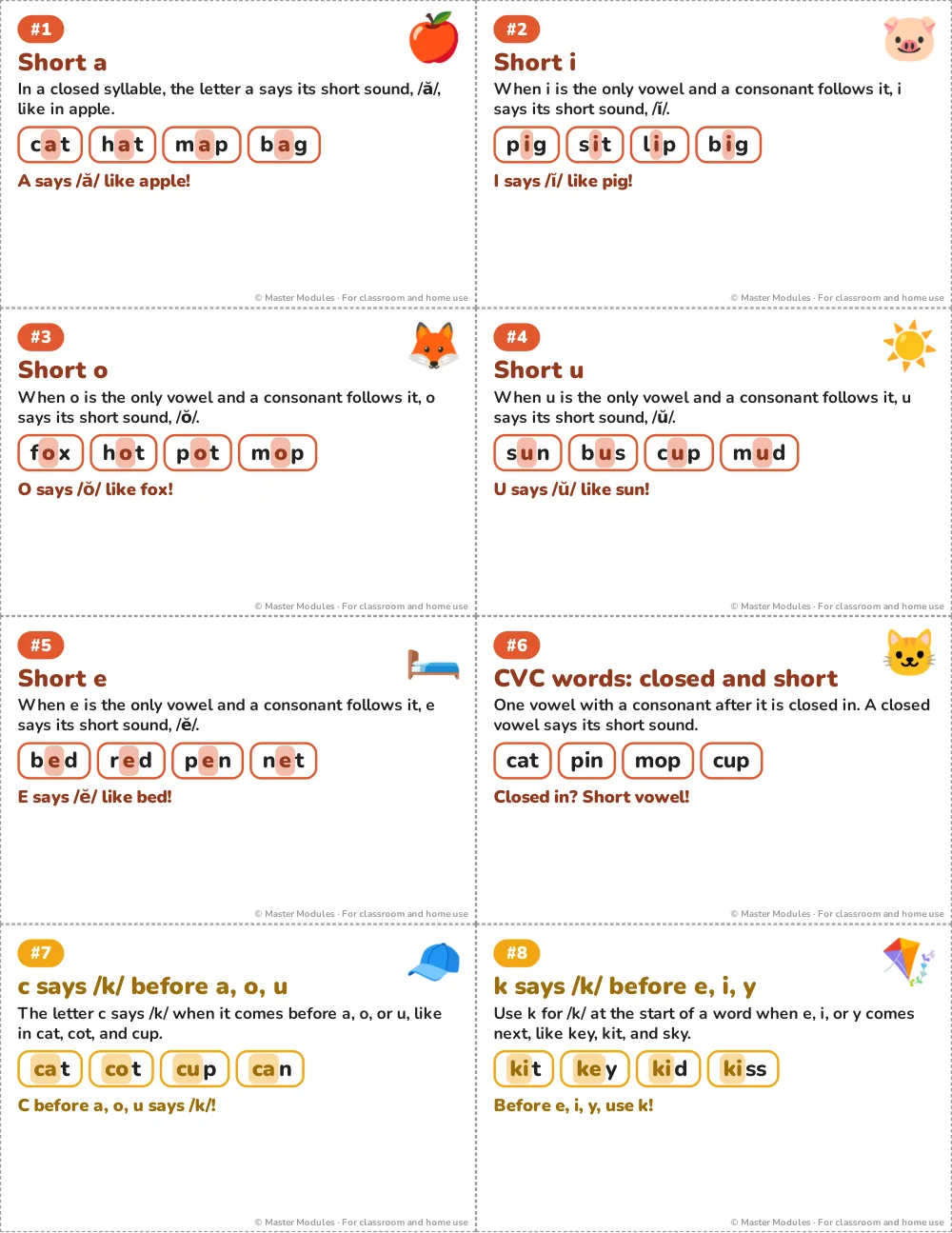
The lists
Short a
In a closed syllable, the letter a says its short sound, /ă/, like in apple.
cat, hat, map, bag, sad, jam, fan, cap, ran, tap, dad, mad, bat, rat, van, pan, nap, lap, gas, can
sh
The letters s and h team up to make one sound, /sh/, like in ship and fish.
ship, shop, fish, dish, shell, wish, shut, shed, shin, shock, rush, brush, crash, cash, sheep, shirt, fresh, flash, shape, push
ch
The letters c and h team up to make one sound, /ch/, like in chin and lunch.
chin, chop, much, rich, chip, lunch, chat, check, chest, chair, cheese, chick, bench, pinch, ranch, punch, such, inch, peach, beach
ck after a short vowel
Use ck right after a short vowel at the end of a one-syllable word.
back, pack, sack, neck, deck, sick, kick, lick, pick, rock, sock, lock, dock, duck, luck, truck, stick, black, clock, chick
FLOSS rule (ff, ll, ss, zz)
At the end of a one-syllable word with one short vowel, double f, l, s, or z.
puff, huff, stuff, off, bell, hill, doll, fill, tell, pill, kiss, miss, mess, boss, toss, fuzz, buzz, fizz, jazz, cliff
-tch after a short vowel
Use tch to spell /ch/ right after a short vowel at the end of a one-syllable word.
catch, match, patch, pitch, fetch, ditch, hatch, latch, batch, witch, switch, stitch, itch, notch, hutch, sketch, stretch, scratch, crutch, clutch
-dge after a short vowel
Use dge to spell /j/ right after a short vowel at the end of a word.
badge, edge, bridge, fudge, hedge, lodge, dodge, ridge, pledge, judge, smudge, trudge, budge, wedge, nudge, grudge, fridge, ledge, sludge, dredge
Magic e: a_e
A silent e at the end makes the vowel before it say its name. In a_e, a says /ā/.
cake, make, game, name, lake, gate, bake, wave, cave, tape, cane, safe, late, shape, plate, snake, skate, grape, flame, take
Magic e: i_e
A silent e at the end makes the vowel before it say its name. In i_e, i says /ī/.
bike, kite, time, five, line, smile, nine, ride, hide, slide, like, mine, pipe, white, drive, shine, bite, wide, prize, dime
ai in the middle
Use ai to say /ā/ in the middle of a word. English words almost never end in ai.
rain, mail, tail, train, snail, paint, wait, sail, pail, nail, pain, main, brain, chain, drain, faint, trail, plain, aim, maid
ay at the end
Use ay to say /ā/ at the end of a word or syllable.
day, play, stay, say, tray, gray, way, may, pay, hay, lay, ray, clay, spray, stray, sway, pray, today, away, Sunday
ee
The two letters ee work together as a team to say /ē/. Ee is found in the middle or at the end.
bee, see, tree, free, three, feet, seed, weed, need, feed, green, queen, sleep, sheep, sweet, teeth, cheese, street, deep, keep
oa in the middle
Use oa to say /ō/ in the middle of a word. Words do not end in oa.
boat, coat, goat, road, soap, toad, load, oak, oats, foam, roam, moan, groan, float, throat, coach, toast, roast, loaf, cloak
ar
The letters ar say /ar/, like the sound a pirate makes. The r changes the vowel.
car, far, jar, bar, star, farm, barn, park, dark, shark, yard, card, hard, start, smart, market, garden, carpet, arm, art
or
The letters or say /or/, as in corn and fork. The r changes the vowel.
or, for, nor, corn, fork, horn, horse, storm, born, torn, sort, short, sport, port, cork, thorn, north, porch, morning, forty
er, ir, ur (same sound)
Er, ir, and ur all say /er/. You cannot hear which spelling to use, so check the word.
her, fern, verb, term, bird, girl, dirt, shirt, first, stir, skirt, turn, burn, hurt, nurse, purse, curl, fur, surf, church
Make your own lists
You can build a list for any rule in a few steps.
- Name the pattern in one sentence.
- Collect twenty words that follow it and are likely to be familiar to your class.
- Check each word against the rule. A list with a wrong word teaches the wrong lesson.
- Add two or three contrast words (words that look similar but do not follow the rule).
- Sort by difficulty. Put one-syllable words first and longer words after.
Good sources are your reading materials, the class word wall and the decodable books you already use.
Using lists across the week
| Day | Activity |
|---|---|
| Monday | Teach the rule, read the list |
| Tuesday | Sort the list against a contrast group |
| Wednesday | Dictate five words |
| Thursday | Use the words in sentences (see the decodable sentences guide) |
| Friday | Short quiz, then add the list to a notebook |
Lists and the larger plan
Word lists make most sense when they follow a sequence. The full list of spelling rules shows the order in which these patterns usually come, and the 36-week pacing guide shows how to fit them into a year. For the rule behind the ck list above, see the ck guide.
Lists for all 130 rules
The 16 lists above come from the same data as Word Lists for Every Rule, an optional add-on sold with the Phonics & Spelling Rules Posters. The add-on has a list for each of the 130 rules. The main poster set contains the posters themselves, an Index of All 130 Rules, a Quick-Start Teacher Guide, 130 decodable sentence cards and a 36-week planner, but not the full word lists.