Printable Decodable Books: How to Print, Assemble and Save Ink
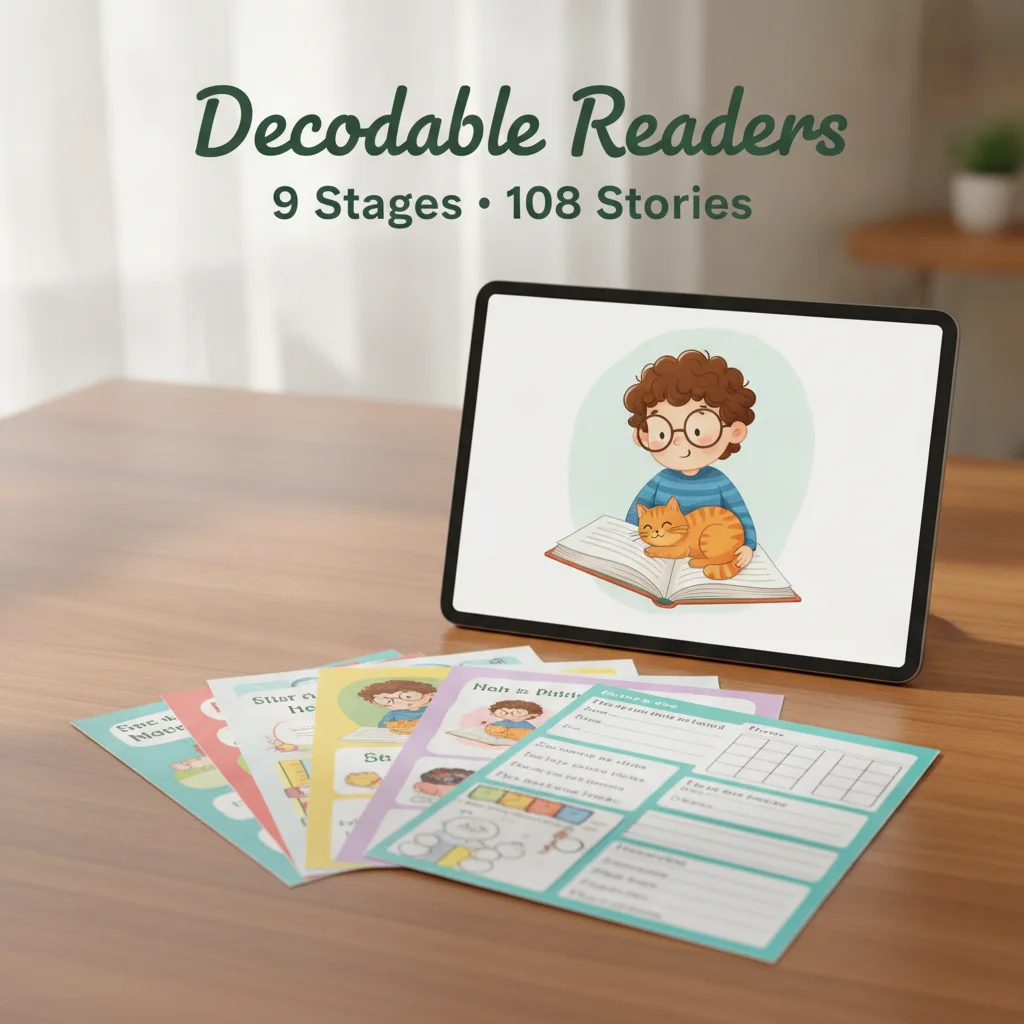
A printable decodable book is a PDF you print at home and turn into something a child can hold and read. This guide covers choosing the format, setting up your printer, saving ink and putting the pages together so they last. It also describes how the printable files in The Decodable Readers Library are organized, so you know what you will be printing.
Color or black and white?
| Color | Black and white | |
|---|---|---|
| Looks | Illustrated pages, very inviting | Clean line art, ready to color |
| Ink | Uses more | Uses much less |
| Best for | Story pages the child will read many times | Activity pages, centers, extra copies |
| Extra benefit | The pictures can keep a young child engaged | The child can color the pictures as a reward |
A common approach is to print stories in color for the main reading copy and use black and white for activity pages and for second children. In The Decodable Readers Library, every stage comes in both versions, so you can mix them.
Print settings that matter
- Paper size. US Letter.
- Scale. 100 percent. Do not choose "fit to page", which shrinks the layout.
- Duplex. If your printer can print on both sides, do it: each story packet is four pages, so it needs two sheets.
- Quality. Standard is fine for stories. Draft mode is enough for activity centers.
- Test page. Print one story first to check that the margins and colors look right.
What to print first
Do not print the whole library on day one. A sensible order is below.
- The placement test. It is a short PDF and tells you where to begin.
- The Start Here and Parent Guide pages that matter now. Read the first few pages of the guide, then go.
- One stage of stories. For a stage with 12 stories, print a week of packets at a time.
- One activity center at a time. Add a center after the matching stories are done.
How to assemble a decodable book
There are several ways to turn printed pages into a book, depending on how much work you want to do.
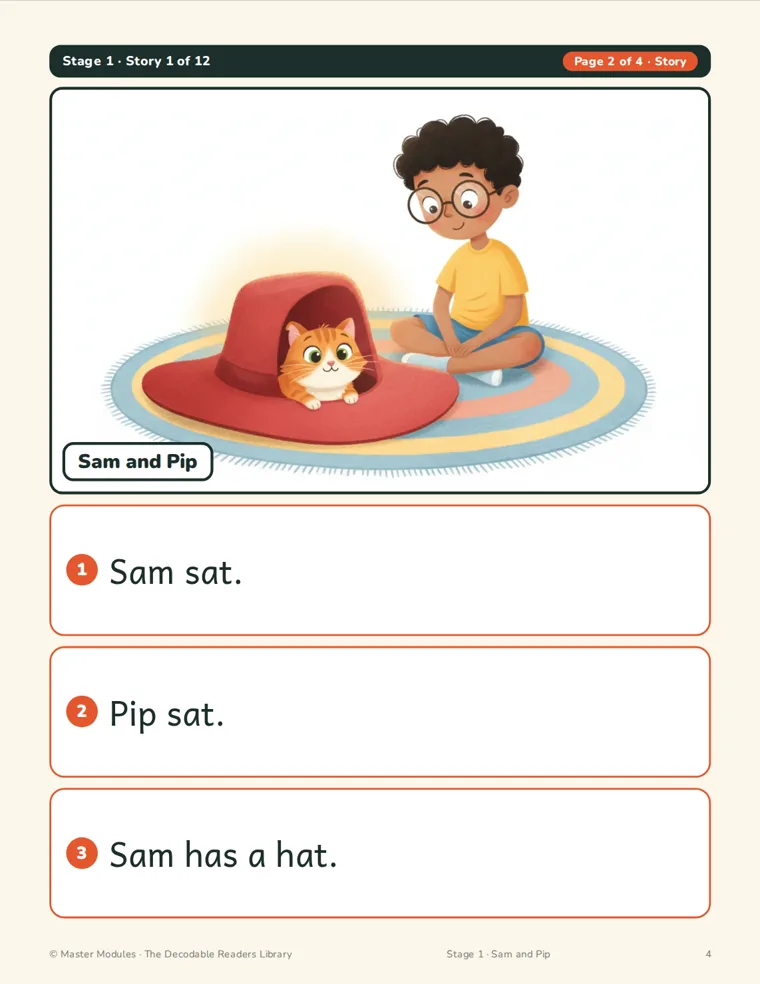
- Stapled packet. Staple the four pages of a lesson packet in the corner. This is the simplest version.
- Folder or binder. Punch holes and keep a stage binder with its 12 packets. It feels like a real book on the shelf.
- Folded and stapled booklet. Fold the story pages in half and staple along the spine for a small booklet the child can hold.
- Sheet protectors. Slide a page into a sheet protector and use a dry-erase marker for the activities. Wipe and reuse.
Use card stock for cards and tiles, since they get handled more.
Saving ink
- Use the black and white files for everything except the reading copy.
- Print the activity centers in draft mode.
- Print only what you will use this week.
- Print one copy and reuse it with sheet protectors instead of printing worksheets again.
How the library's printables are organized
The Decodable Readers Library is a set of PDFs.
| Part | What it is |
|---|---|
| Start Here | A short guide to the first five minutes |
| Parent Guide | What to say on every page, with routines and scripts |
| 3-Minute Placement Test | Word lists for each stage, a child page and a grown-up scoring sheet |
| Readers, Stages 1 to 9 | 12 illustrated decodable stories for each stage, in color and in black and white |
| Activity centers, Stages 1 to 9 | 8 centers per stage, in color and in black and white |
| Progress Tracker | A tracker for each stage, a fluency log, sticker sheets and a wall chart |
| Certificates | One for each stage, and a final one |
In total there are 9 stages, 12 stories each, so 108 stories. Each story is a four-page lesson packet: a warm-up page, the six-page story shown across pages two and three and an activity page. A members web app is included as well.
A note on length: the files are image-rich, so PDFs are large. Download them to your computer first and print from there, not from a phone.
Prep tips from the Parent Guide
The Parent Guide's printing section gives a short list worth repeating.
- US Letter, 100 percent scale, not "fit to page".
- Color or black and white: both versions are included.
- Print duplex if you can.
- Card stock for tiles and cards; a laminator or sheet protectors for reusable pages.
- Staple each packet or punch holes and keep a binder per stage.
- Black and white files use no color fills, so they print cleanly even on a basic laser printer.
- Start with the placement test and one stage, and print more each week.
Printed or on a screen?
Printing has a clear advantage for early readers: the child can point under each word, tick off a story and write in the activity boxes. For that reason, the library is designed for print, with a web app as an extra for tracking progress and finding a starting stage.
Next steps
If you are choosing a starting point for a young reader, see decodable books for kindergarten. For a tour of every stage, read decodable readers: the 9 stages, and for hands-on practice, printable blending cards. If the term is new to you, begin with what decodable books are.