Reading Practice for Kindergarten: 10 Ideas That Fit in 10 Minutes
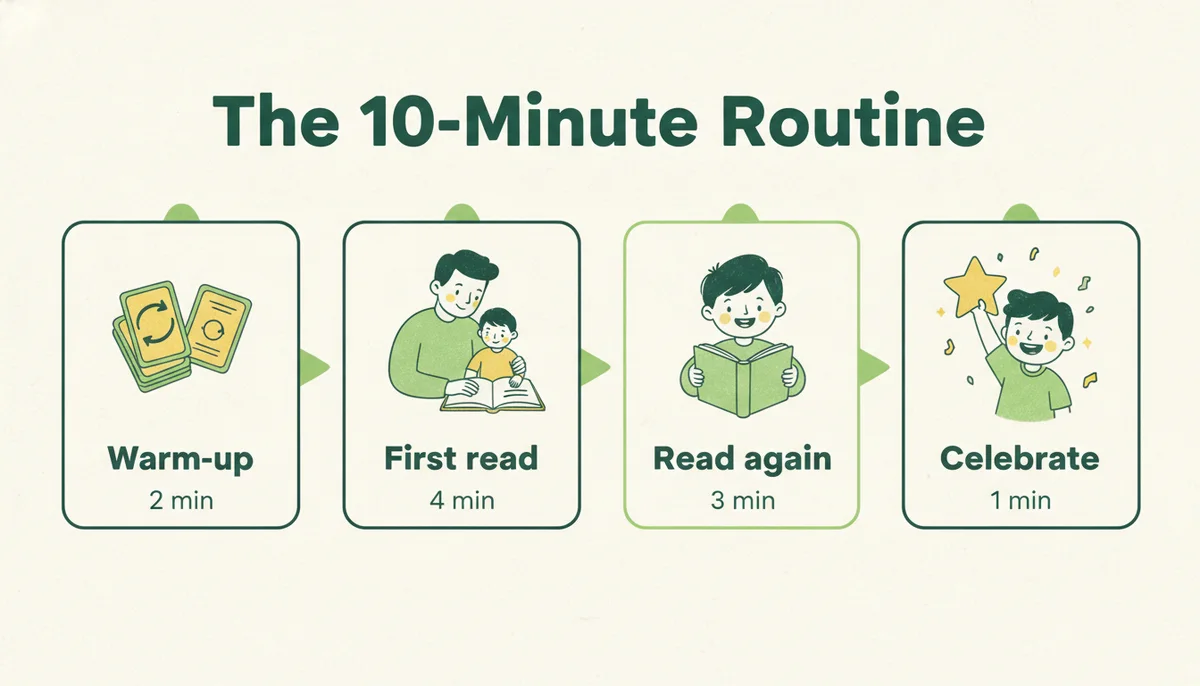
Daily reading practice for kindergarten works best when it is short, predictable and built from text the child can truly read. Here are ten activities, in the order of a ten-minute session, followed by a weekly plan. They come from the routine in The Decodable Readers Library, but you can use the same ideas with any text that matches the sounds your child has learned.
The ten-minute session
1. Warm up the new sounds (1 minute)
Before the story, say the new sounds together. Ask for a word that has each one. This takes a minute and makes the story easier.
2. Tap and slide the new words (1 minute)
Take a few words from the story and tap a finger under each sound, then slide the sounds together and say the word: /k/ /a/ /t/, "cat".
3. Review the tricky words (30 seconds)
Say the tricky words that will appear, such as the, is and to. Point out the part that is a surprise.
4. Speed read a short list (1 minute)
Read a list of the story's words three times. Color a star each time to show the reading got smoother.
5. First read (2 minutes)
The child reads the story, page by page. You help only when asked or stuck. If a word is a problem, tap and slide it together.
6. Second read (1 minute)
Read it again. The second read should be smoother and faster.
7. Talk about it (1 minute)
Ask a question or two. Who was in the story? What happened? What do you think happens next?
8. Word hunt (optional, 1 minute)
Find and circle a few words from the story. This keeps the child looking at the letters.
9. Write a sentence (optional, on another day)
Complete a sentence from the story, for example Sam has a ___., and copy it onto a line. Skip it if your child is tired.
10. Celebrate (30 seconds)
Add a sticker. Stop while it is still fun.
A weekly plan
| Day | Practice |
|---|---|
| Monday to Thursday | One new story: warm-up, two reads and a talk |
| Friday | Re-read two old favorites and play one activity center |
| Weekend | Read for fun: signs, menus and library books |
A stage of 12 stories takes about two to three weeks at one story a day.
What a lesson looks like in the library
In The Decodable Readers Library, each story is a four-page packet.
| Page | What it holds |
|---|---|
| 1 | Warm-up: sounds in the story, tap-and-slide words, tricky words and a speed read |
| 2 and 3 | The story |
| 4 | Three questions, a word hunt, a sentence to write and a space to draw |
Here is an example from Stage 1. The story The Fat Cat has six short pages: Pip is a fat cat. Pip has a nap. Sam can tap Pip. Pip is mad. Pip ran at a rat. The rat ran. Pip ran. Pip is fat! Pip and the rat sat. A nap! The child can sound out every word, because the story only uses short a and short i, a few consonants and the tricky words a, and, has, is and the.
Hands-on practice with activity centers
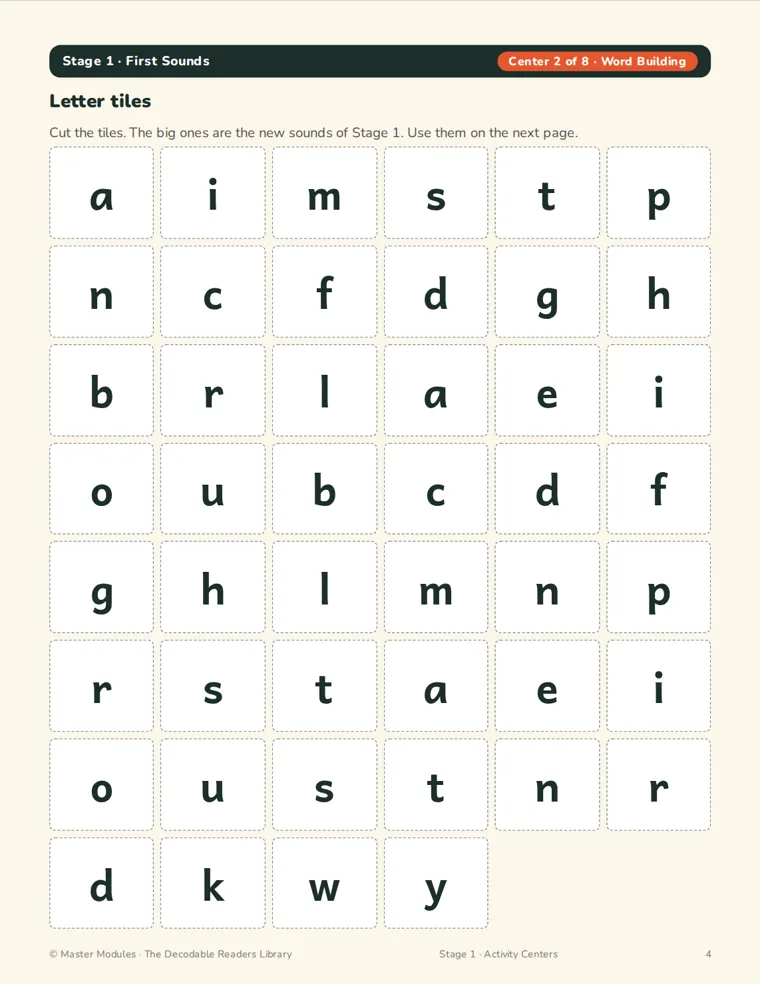
Each stage has 8 activity centers that reuse the words from the stories. One center takes five to ten minutes.
| Center | What it does |
|---|---|
| Picture word cards | Match each picture to its story and words |
| Word building | Build words with letter tiles |
| Clip cards | Choose the right word for a sentence |
| Roll and read | Roll a die and read that row of words |
| Tracing | Practice handwriting |
| Sentence scramble | Put words in order to make a sentence |
| Read and match | Match sentences to pictures |
| Reward chart | See progress at a glance |
A clothespin and a die are the only supplies you need.
Tips for kindergarten readers
- Keep sessions short. Ten good minutes beat thirty tearful ones.
- Point under each word. It keeps the eyes on the letters.
- Cover the picture if your child keeps looking at it instead of the words.
- Praise the effort. "You sounded that out!" is better than "good job."
- Reread favorites. That is where smoothness comes from.
- Never say "just guess". Say "Sound it out" instead.
Finding the right level
If your child cannot read the story, it is too hard for now. Go back one story and do the warm-up twice. If your child reads it with ease on the first try, move forward. A short placement test, such as the 3-Minute Placement Test in the library, shows where to start so practice is neither too easy nor too hard.
Keeping track
A kindergartner loves to see progress. The Progress Tracker has a page for each stage with a place to tick the warm-up, three readings and the activities, a star for smooth reading and a wall chart of all 108 stories. A certificate marks each completed stage.
For where to start, see decodable books for kindergarten. To build a longer routine, read homeschool phonics practice, and to record progress, see reading trackers and certificates. If blending is the sticking point, read how to teach blending.