Homeschool Phonics Practice: A 10-Minute Daily Routine That Works
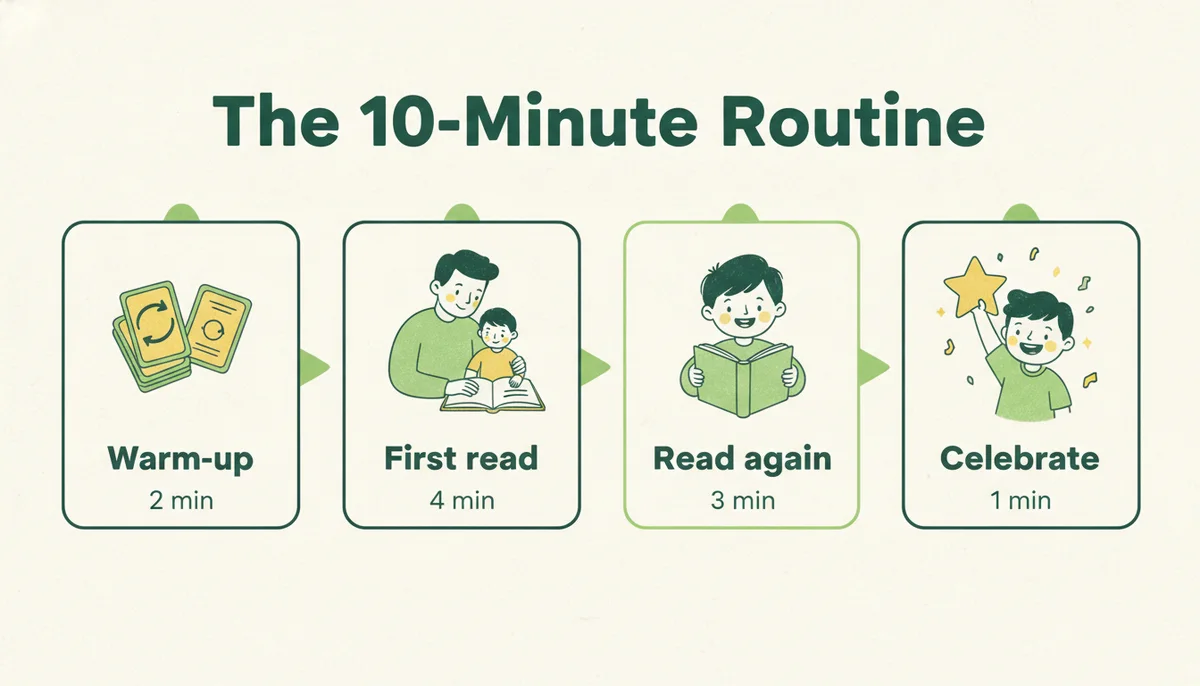
You do not need a teaching degree or an hour a day to teach phonics at home. You need a clear order of sounds, a text that matches what you have taught and a short routine you can repeat. This guide gives a ten-minute daily routine, a weekly rhythm and an honest account of what this kind of practice covers and what it leaves out.
First, what this is and what it is not
Phonics practice teaches a child to connect letters to sounds and use that to read words. It is one strand of reading and language arts. A full homeschool language arts plan usually adds handwriting, spelling, grammar, vocabulary and a lot of reading aloud.
The Decodable Readers Library covers the phonics and early reading strand: a placement test, nine stages of decodable stories, activity centers, a parent guide and a progress tracker. It is not a complete language arts curriculum, and it is better to say so plainly. Many families use it as the reading core and add other subjects around it.
Step 1: Find the starting stage
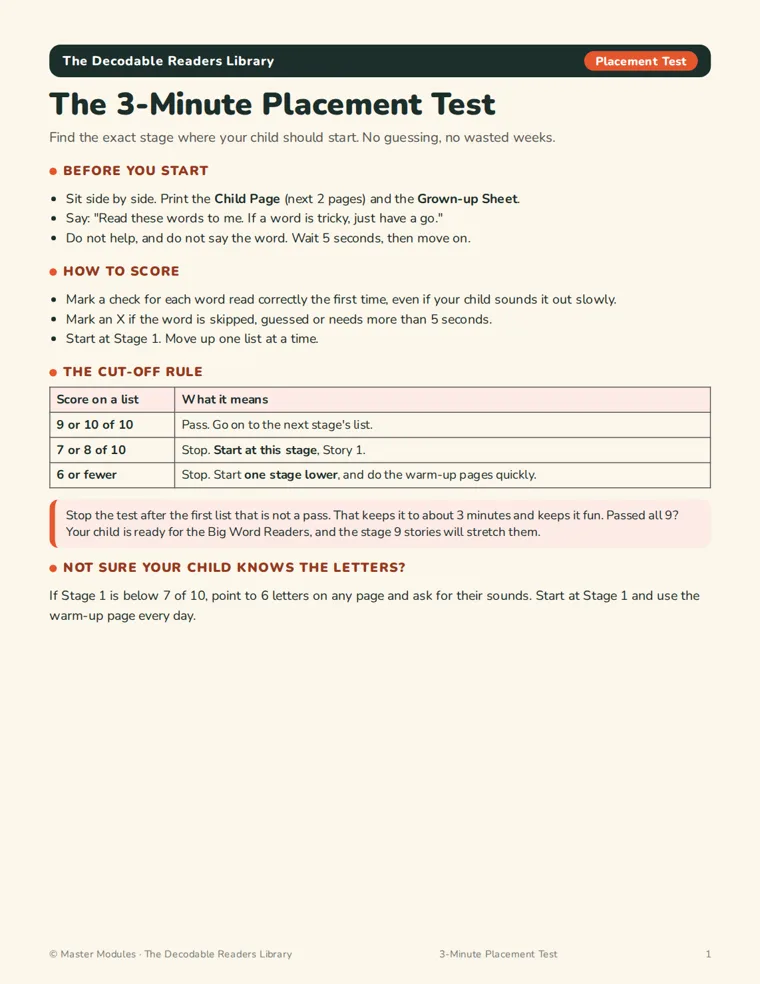
Age is a weak guide. Use a placement test. The 3-Minute Placement Test has a list of 10 words for each of 9 stages. You score each list and stop at the first one that is not a pass (9 or 10 of 10 is a pass). A score of 7 or 8 means start at that stage, and 6 or fewer means start one stage lower. See the phonics screener guide for the full steps.
Step 2: The 10-minute lesson
Each story arrives as a four-page packet. Here is how a day works.
- Warm-up (about 2 minutes). On page 1, say each new sound, tap and slide the words and read the tricky words. Read the speed-read list.
- First read (about 3 minutes). Your child reads the story on pages 2 and 3. You help only when asked or stuck.
- Second read (about 2 minutes). Read it again, smoother and faster.
- Talk (about 2 minutes). Ask the three questions from page 4 out loud.
- Done (about 1 minute). Sticker, high five.
Write in the activities on another day if your child is tired. One packet per day is a good pace, and a stage of 12 stories takes about two to three weeks.
Step 3: A weekly rhythm
| Day | Plan |
|---|---|
| Monday to Thursday | One new story packet |
| Friday | Re-read two old favorites and play one activity center |
| Weekend | Read for fun: library books, signs, menus |
The Friday center gives hands-on practice with the same words. Each stage has 8 centers: picture word cards, word building, clip cards, roll and read, tracing, sentence scramble, read and match and a reward chart.
Step 4: What to say when your child guesses
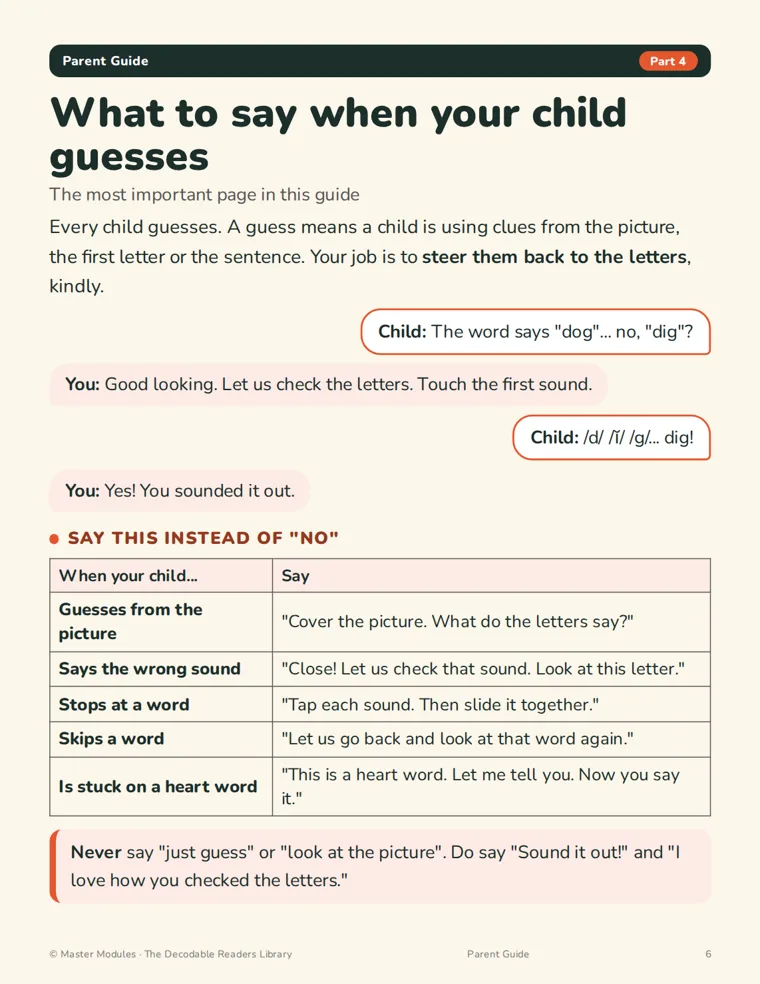
This is the part of teaching that feels hardest. Every child guesses. Steer them back to the letters, kindly.
| When your child... | Say |
|---|---|
| Guesses from the picture | "Cover the picture. What do the letters say?" |
| Says the wrong sound | "Close! Let's check that sound. Look at this letter." |
| Stops at a word | "Tap each sound. Then slide it together." |
| Skips a word | "Let's go back and look at that word again." |
| Is stuck on a tricky word | "This is a heart word. I'll tell you. Now you say it." |
Avoid "just guess" and "look at the picture". Say "Sound it out!" and "I love how you checked the letters."
Step 5: When to move on, and when to stay
Watch your child, not the calendar.
| If your child... | Do this |
|---|---|
| Reads a story accurately on the second read | Move to the next story |
| Needs help on most words | Re-read, or go back one story, and do the warm-up twice |
| Reads all 12 stories of a stage smoothly | Celebrate and start the next stage |
| Finds a stage very easy | Re-take the placement test and skip ahead |
| Hits a wall at a certain stage | Stay a bit longer and mix in activity centers |
Re-test every six to eight weeks to confirm the right level.
Keeping a record
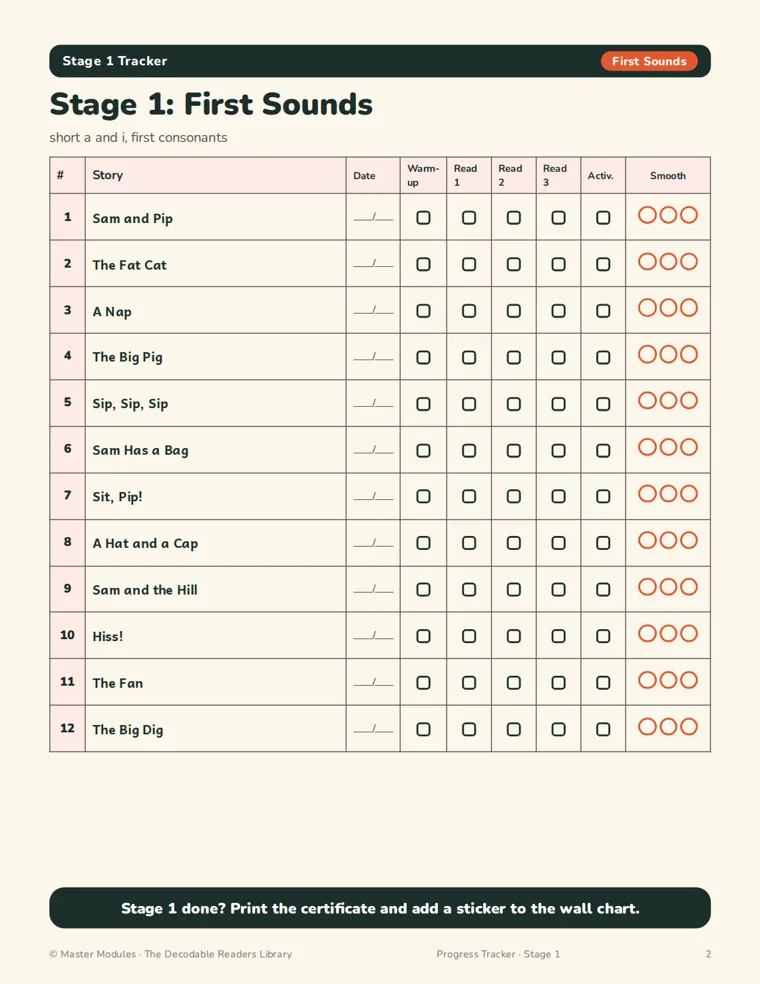
Homeschool families often need to show progress, and a simple record also keeps a child motivated. The Progress Tracker has a page for each stage with columns for the date, warm-up, three readings and activities, and a smooth-reading star. It also has a fluency log for timing one minute of a reread story once a week, two sticker sheets and a wall chart of all 108 stories. A certificate marks each finished stage.
What a typical year might look like
There is no fixed schedule, because children move at different speeds. As a rough guide, one packet per school day means a stage of 12 stories takes two to three weeks, and nine stages can take most of a school year or more. A child who starts at Stage 4 after the placement test will cover fewer stages. The point is to move by accuracy, not by the calendar.
Combine it with the rest of your day
Pair the ten-minute lesson with:
- Read-alouds. Read rich stories to your child every day to build vocabulary and a love of books.
- Handwriting. The activity page asks for a sentence to copy, which gives a little writing practice.
- Talk. Ask questions about the story to build comprehension.
What the Parent Guide adds
The Parent Guide explains how sounding out works, how to say sounds cleanly, how to teach tricky words in one minute, how to use the activity pages and centers, how to build fluency and what to do when problems come up. It includes a page for each stage with the sounds, tricky words and rules in kid-friendly language.
To go further, see 10-minute reading practice for kindergarten, tracking progress with certificates, the phonics scope and sequence and the phonics screener.