Phonics Posters for the Classroom: How Many You Need
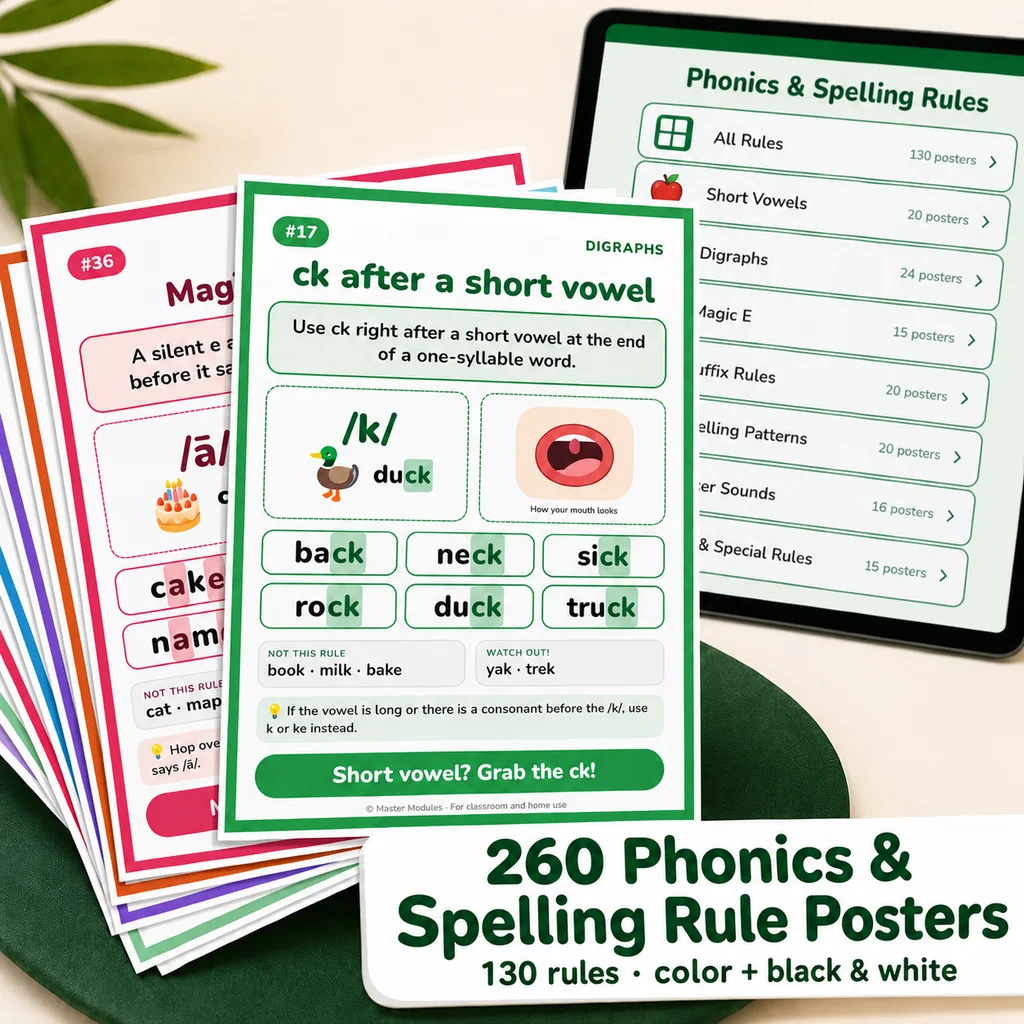
You do not need 130 posters on the wall at once. You need the right few at the right time. For most classrooms that means the rule you are teaching this week, the last few you taught and a way to look up older ones. This guide lists what to post, what to keep in hand and how to plan wall space, using a 130-rule set as the example.
The short answer
| Where | How many | What goes there |
|---|---|---|
| Main wall | 3 to 6 | Current rule plus the most recent rules |
| Reference binder | All of them | Half-page copies in rule order |
| Student notebooks | 1 to 2 per week | Mini versions of the current rule |
| Small-group table | The rules for that group | Half-page copies |
| Take-home | 1 per unit | Mini version plus a short note to the family |
Why a smaller wall works better
A wall with 130 posters is hard to read. Children stop looking at it. Teachers lose the sense of "this is today's rule". A rotating display solves this:
- The current rule is always at eye level.
- The last two or three stay up, so students can refer back.
- Older rules go into a binder or ring where students can still find them.
This makes the wall a teaching tool, not wallpaper.
Which rules to post first
If you can only post a few early in the year, start with the rules that cover the most words.
- Short vowels (a, e, i, o, u) and the closed-syllable idea.
- Digraphs: sh, ch, th, wh, ng, nk.
- The endings that protect short vowels: ck, FLOSS (ff, ll, ss, zz), -tch, -dge.
- Magic e: a_e, i_e, o_e, u_e, e_e.
- The vowel teams in the order you teach them.
A set of ten "most asked about" rules is a handy quick reference too. The rules kids ask about most tend to be the ones with famous exceptions: ck, FLOSS, plural -es, -ed, magic e, soft c, doubling, drop the e, change y to i, and "i before e". The full list of rules shows where each fits.
Sizes and what each is for
| Size | Best for |
|---|---|
| Full page | The wall, the board, the front of the room |
| Half page | Small groups, reading corner, binder pages |
| Mini | Notebook corners, folders, desk reference, take-home |
Use a mix. A child who sees ck after a short vowel on the wall, in a binder and on the corner of a notebook has met the rule three times.
Color or black and white
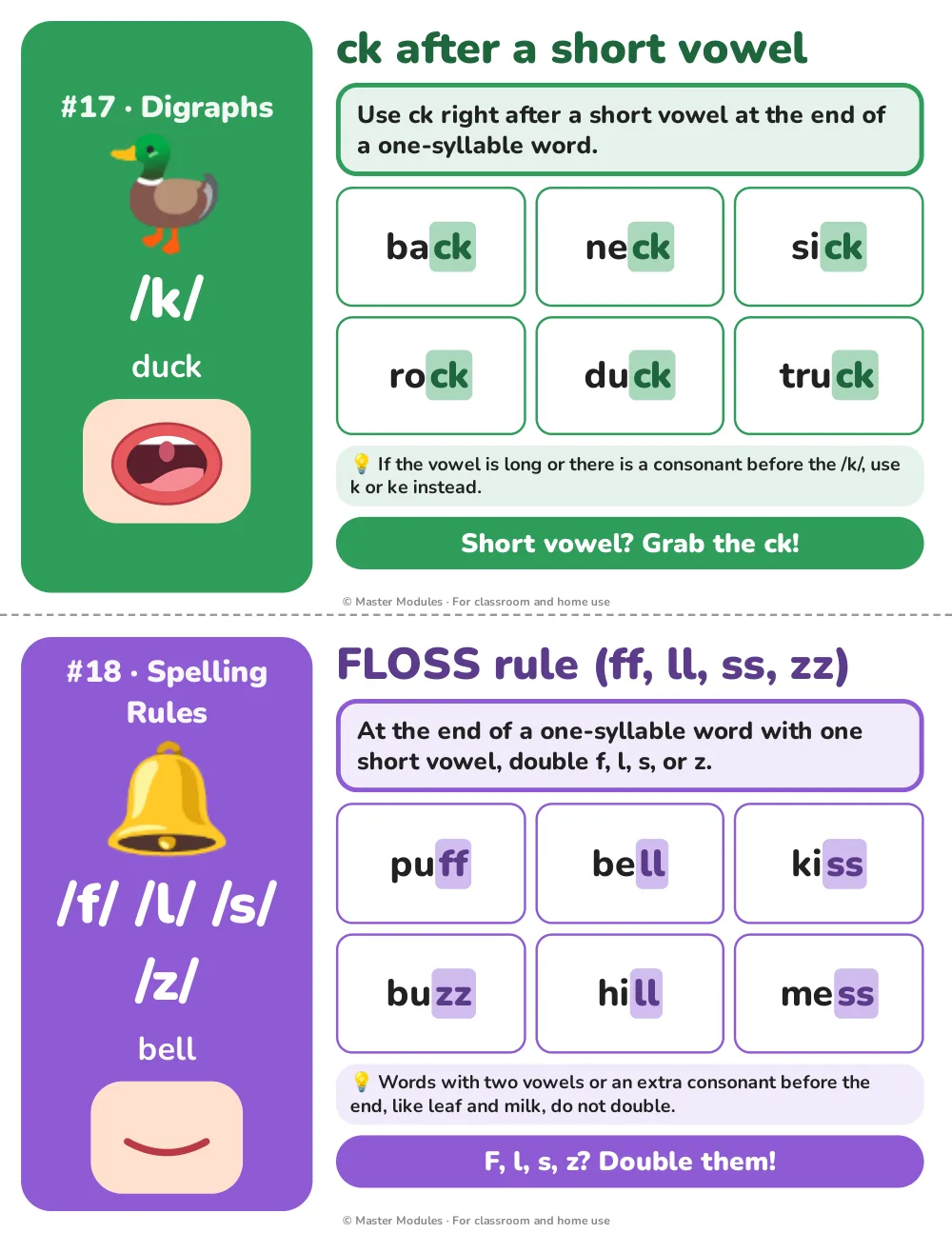
- Color for the wall. Color-coding by category (digraphs, blends, vowel teams and so on) helps students find a poster quickly.
- Black and white for anything students handle or color in, and for classrooms that print on a budget.
If your printer is limited, print the wall posters in color and everything else in black and white.
What a good phonics poster contains
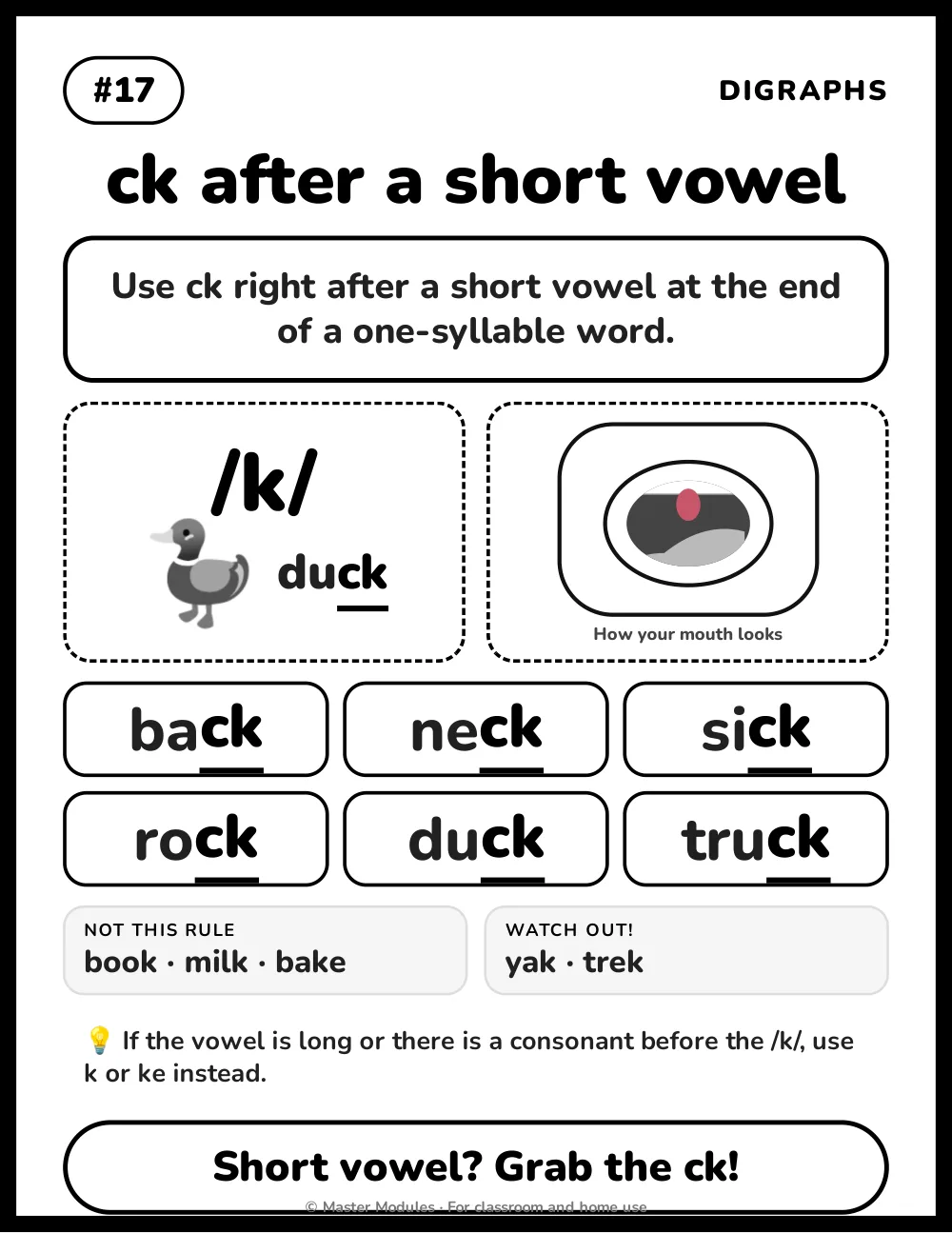
When you look at a poster, whether you buy it or make it, check for:
- The rule in plain language, in one or two sentences.
- Six or so example words with the pattern highlighted.
- A contrast. Words that do not follow the rule, so students see its edges.
- The real exceptions, named honestly.
- A decodable sentence using the pattern.
- A short kid-friendly line to say aloud.
Posters that only show a letter and a picture do not teach a rule. Posters that give a rule without a contrast or exceptions can leave students with the wrong idea.
A weekly rotation
| Day | Wall |
|---|---|
| Monday | Hang the new rule at eye level |
| Tuesday to Thursday | Use it in a short warm-up |
| Friday | Move last week's rule to the "recent" row |
| Every sixth week | Review: put up the five weeks' rules together |
A year planned this way fits the 36-week structure described in the lesson plan guide.
Pairing posters with a sound wall
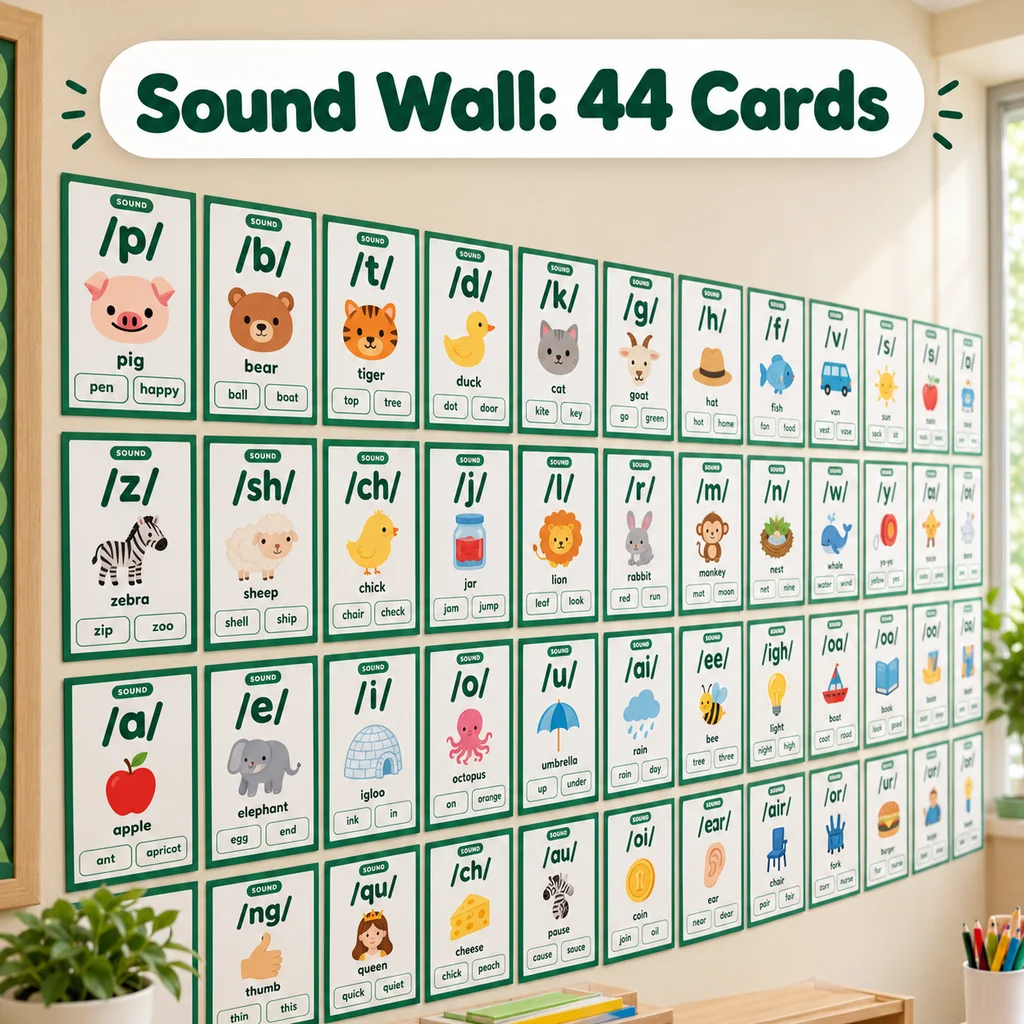
Rule posters and a sound wall do different jobs. The wall shows which sounds exist and how to make them; the rule posters explain how to choose between spellings. See how to set up a classroom sound wall and the 44-sound chart.
About the Phonics & Spelling Rules Posters
The Phonics & Spelling Rules Posters set has 130 rules. Each rule is a poster in color and in black and white, with full-page, half-page and mini versions. Alongside the posters come the Index of All 130 Rules, a Quick-Start Teacher Guide with a 5-minute poster routine, 130 rule bookmarks, 130 decodable sentence cards, a 36-week planner with a mastery tracker, parent take-home letters and a one-page poster of the ten rules kids ask about most. Word lists, notebook pages, a sound wall and practice sheets are separate add-ons and are not part of the main set.