10-Minute Activities for Kids: A 10-Week Daily Routine
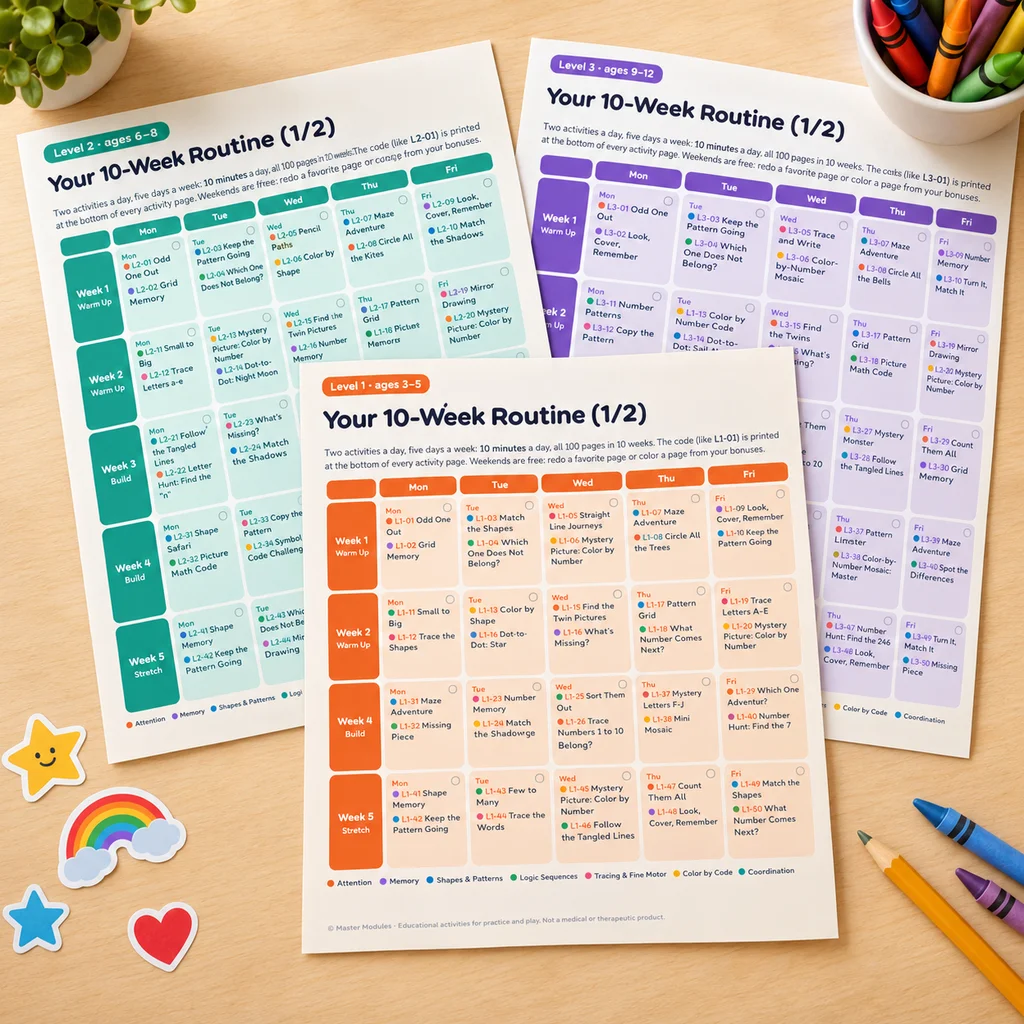
A good daily routine for kids is short, predictable and finishable: 10 minutes, two activities, five days a week. Over ten weeks that adds up to 100 activities, enough to build a real habit without taking over your afternoons. This guide lays out the plan used in the Focus Quest Activity System: how a 10-minute session runs, what each of the five stages involves, and how to adjust if it feels too easy or too hard.
Why 10 minutes?
Ten minutes is long enough to do something that feels complete and short enough that most children will agree to start. A routine that is small is a routine that survives busy weeks. Many families already have a 10-minute gap: after school, while dinner is cooking, or just before bed.
Practice also works better when it is regular. A short block every weekday builds the habit of sitting down, paying attention to one thing, and finishing it. Whether the activity is a maze or a memory game, the habit of finishing is the same.
The plan at a glance
| Length | 10 weeks |
| Days | Monday to Friday (weekends free) |
| Per day | 2 activities, about 10 minutes |
| Total | 100 activities per level |
| Levels | Level 1 (ages 3 to 5), Level 2 (ages 6 to 8), Level 3 (ages 9 to 12) |
The five stages
| Weeks | Stage | What it feels like |
|---|---|---|
| 1 and 2 | Warm Up | Getting into the rhythm; easier pages |
| 3 and 4 | Build | Pages ramp up gradually |
| 5 and 6 | Stretch | Halfway milestone; more challenge |
| 7 and 8 | Challenge | Tougher pages |
| 9 and 10 | Quest Master | Finish line |
In each level, activities run from easier to harder through the 100, so the difficulty rises with the weeks.
A 10-minute session, minute by minute
| Time | Length | Step |
|---|---|---|
| 0:00 | 1 minute | Set the scene: clear the table, pencil and eraser ready, timer set to 10 minutes. Read the day's two activity codes aloud. |
| 1:00 | 4 minutes | Activity one. Read the instructions together, let your child start, and stay nearby without taking over the pencil. |
| 5:00 | 4 minutes | Activity two. A different skill from the first, on purpose, so the session feels fresh. |
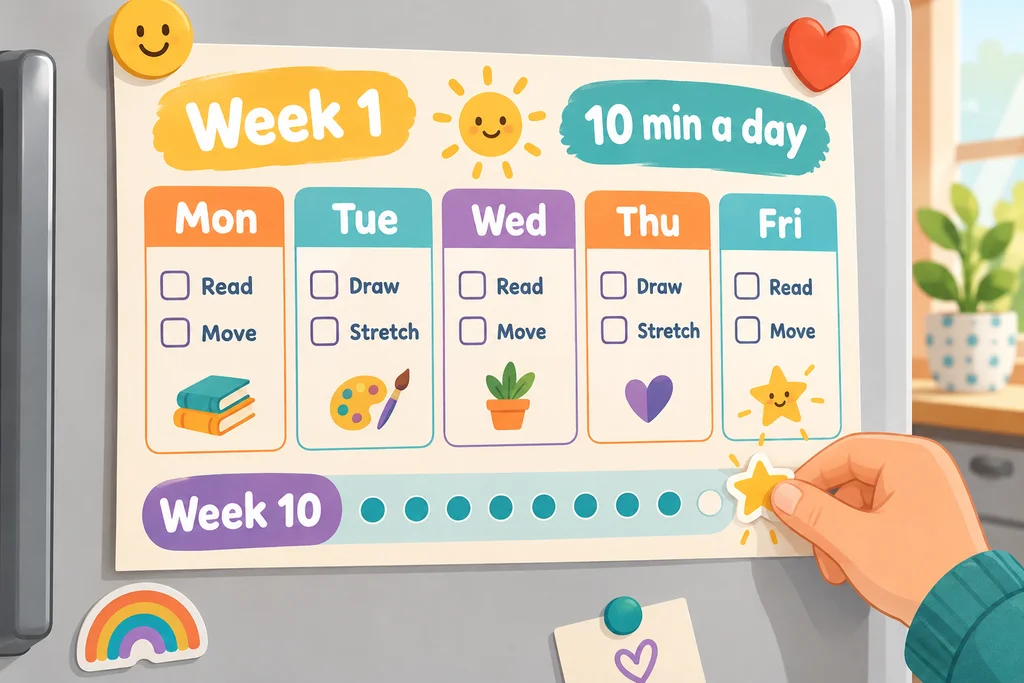
| 9:00 | 1 minute | Tick the box, add a star to the calendar, and say what you noticed: "You kept going on that maze." |
Each activity has a code such as L1-01 printed at the bottom of its page, and the Routine Planner lists which two codes to do each day. That means no deciding what to do next.
What your child practices
The 300 activities cover seven skills, mixed through the plan so that a session usually pairs two different ones:
- Attention: odd one out, circle all, find the pair, spot the differences
- Memory: look-cover-remember, grid memory, what's missing
- Shapes & Patterns: continue the pattern, shadow match, turn and match
- Logic Sequences: order it, number sequences, matrices
- Tracing & Fine Motor: lines, shapes, letters, numbers, words
- Color by Code: mystery pictures and ciphers
- Coordination: mazes, dot-to-dot, tangles
Which level to start on
Start by age, then adjust:
| What you see | What to do |
|---|---|
| Pages are done in a minute or two with no thinking | Try the next level up |
| Pages take some effort, a few tries, and end with a smile | You are in the right place. Stay here |
| Frustration or asking to stop within a couple of minutes | Step down a level for now and come back in a few weeks |
Make it stick
- Pick a fixed time. After snack, before dinner, always the same.
- Use a visible timer. The Focus Quest web app includes a Focus Timer with 5, 10 and 15-minute rings.
- Tick and celebrate. Check off each day on the printable calendar and color a star.
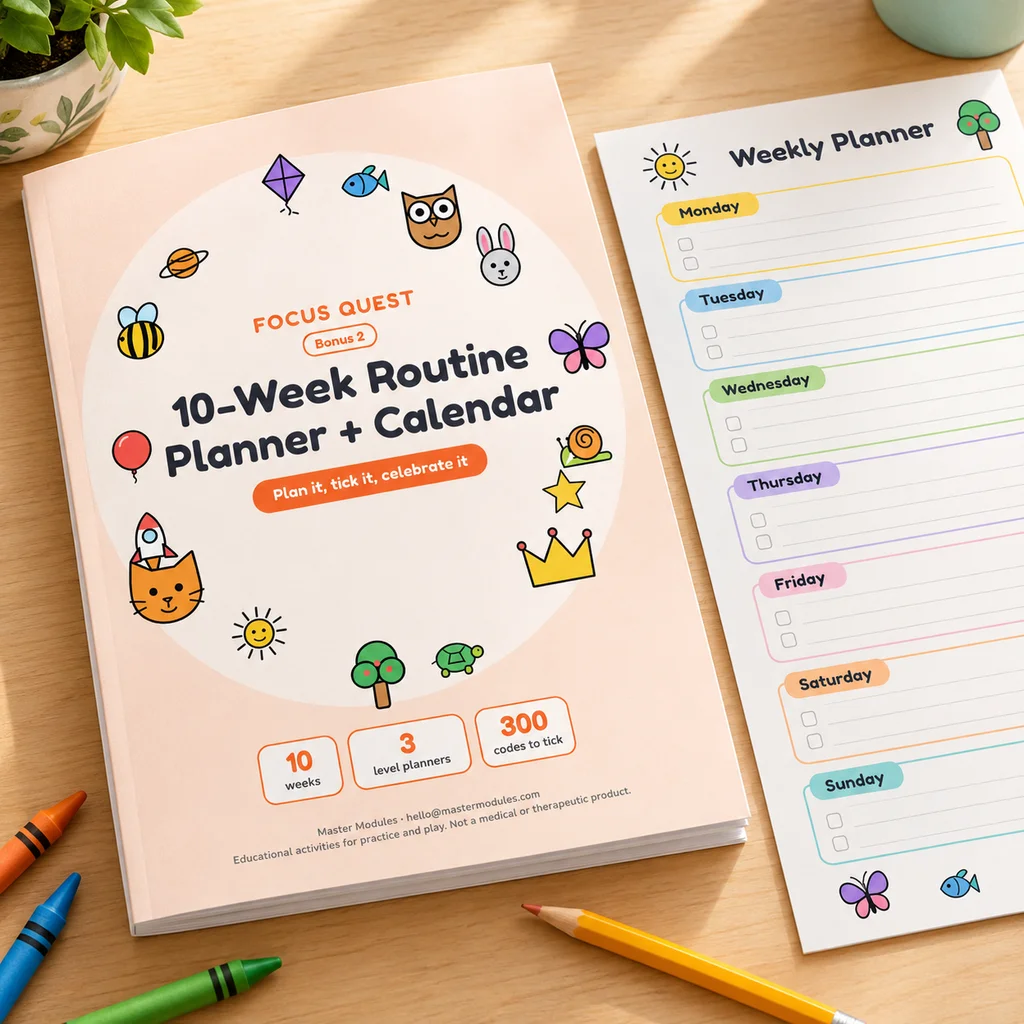
- Plan the milestones. The planner has a goals and rewards page for Week 2, Week 5, Week 8 and Week 10.
- Keep weekends light. A weekend menu offers optional extras such as a coloring page or a Screen-Swap Card, and rest days count too.
For more on rewards, see our guide to printable sticker and reward charts.
What to say, and what to skip
Encouragement matters more than speed. Try "I saw you keep trying that maze" instead of "good job, you're so smart," and "mistakes are how pages get done" instead of "no, not that one, erase it." Stop when the timer rings, even if your child wants to finish one more, which leaves tomorrow's session something to look forward to.
When it gets hard
If your child is stuck, pause for three slow breaths and a sip of water, read the instructions again, find the first step together, or make the task smaller by doing one row or one corner together. If it is still stuck, draw a small star on the page, move on, and come back tomorrow.
What the routine is, and is not
This is a practice routine: it helps children build a habit of sitting down, paying attention and finishing. It is not a treatment or therapy and does not promise results by a set date. If you have concerns about your child's learning or development, talk to your pediatrician or teacher.
Related reading
Struggling with daily focus? Start with child cannot focus: what parents can try. For expectations by age, see attention span by age. To compare this format with loose worksheets, read activity book vs random worksheets, and for the full contents, see what's inside the Focus Quest Activity System.