Attention Span by Age: What Is Realistic for Kids?

There is no official attention span by age chart. Attention varies by task, mood, sleep, hunger and setting, so any table of exact minutes per age is a rough guess. What parents can use instead is a practical method: start with a session length your child can finish, watch how it goes, and extend slowly. This guide explains what is known, what is only folklore, and how to plan realistic activity lengths from ages 3 to 12.
What the "chart" claims, and what is behind it
Search for a chart and you will find the same idea repeated in many versions: multiply a child's age by two or three, and that is how many minutes they can focus. A five-year-old would manage about ten to fifteen minutes, an eight-year-old about sixteen to twenty-four.
It is a convenient shortcut, but it is only that. It is not published as a guideline by pediatric organizations such as the American Academy of Pediatrics or the CDC, and it ignores almost everything that actually changes attention from one moment to the next.
What really changes attention
| Factor | Effect |
|---|---|
| Interest | A child who loves dinosaurs can study them for much longer than they can sit through a worksheet. |
| Task type | Hands-on, finishable tasks hold attention better than open-ended ones. |
| Energy and sleep | A tired or hungry child loses focus sooner. |
| Setting | Noise, screens in view and interruptions shorten sessions. |
| Practice | Children who regularly do short focused tasks tend to find them easier over time. |
| Day and time | After school and late afternoon are often harder than mornings. |
Why games feel different from homework
Many parents notice that a child can play a video game for an hour but cannot do ten minutes of reading. Both involve attention, but of different kinds. A game constantly changes, gives instant feedback and rewards, so attention is pulled along. A reading or math task asks the child to hold attention on their own, with slower feedback. That second kind is a skill that grows with practice, and it is the one children need for school.
That is also why a long session of "free" screen time does not tell you much about how well your child can focus on something quiet.
A practical way to set task lengths
Instead of looking up a number, observe and adjust.
- Watch for a week. Note how long your child stays with a typical activity before drifting. That is the starting point.
- Set the session slightly under that. If they usually drift at six minutes, start with five. Finishing builds confidence.
- Use a visible timer. A shrinking ring or sand timer shows the end.
- Add a minute when it feels easy. Do not jump from five to twenty.
- Keep it consistent. Daily practice beats occasional long sessions.
Session ideas by age band
These are starting suggestions for practice sessions, not norms. They match the three levels in the Focus Quest Activity System.
| Age band | Typical starting session | What works well |
|---|---|---|
| 3–5 (Level 1) | 5 to 10 minutes, one or two pages | Matching, simple mazes, tracing lines, finding the odd one out |
| 6–8 (Level 2) | About 10 minutes, two pages | Memory games, patterns, dot-to-dot, color by code |
| 9–12 (Level 3) | 10 to 15 minutes, two pages | Logic sequences, mirror drawing, ciphers, longer mazes |
The system is built around 10-minute sessions with two activities, five days a week, over ten weeks. That length was chosen because it fits easily into an after-school routine and is short enough to finish.
What the activities practice
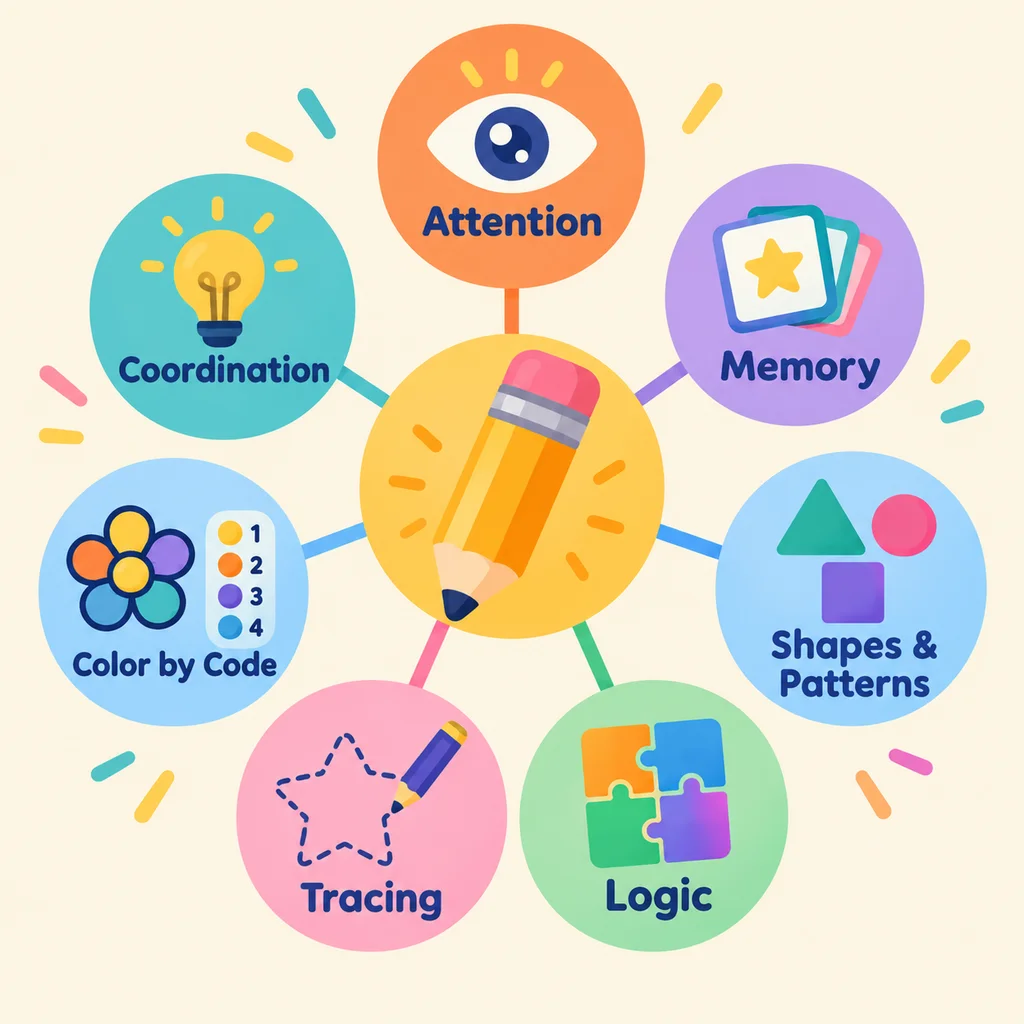
The 300 activities are spread over seven skills, with 100 pages in each level:
- Attention (45 pages): odd one out, circle all, find the pair, spot the differences, count the objects
- Memory (42): grid memory, look-cover-remember, what's missing, number memory
- Shapes & Patterns (42): continue the pattern, shadow match, rotate and match
- Logic Sequences (42): order it, number sequences, which one does not belong
- Tracing & Fine Motor (42): lines, shapes, letters, numbers, words
- Color by Code (42): mystery pictures, mosaics, ciphers
- Coordination (45): mazes, dot-to-dot, tangles
Because every page ends, a child can see progress after each one. An Answer Key Book with all 300 solutions lets a grown-up check the work in seconds.
How to lengthen sessions gradually
If your child finishes the starting session easily for about a week, add a small step. Add one minute, or add a slightly harder page, but not both at once. A simple pattern is: easy week, same week again, then a small increase. If a week goes badly because of illness, travel or a busy schedule, go back to the shorter length without fuss. The goal is a steady habit, not a record.
Signs you are asking for too much
- The child is frequently in tears or avoiding the activity before starting.
- Mistakes lead to quitting instead of trying again.
- Each session needs a lot of reminders from you.
If you see these, shorten the session or move down a level. Success matters more than length.
When to get another opinion
If you have concerns about your child's attention, learning or development, talk to your pediatrician or teacher. They can look at the full picture, which no chart can. The activities here are educational practice and play, not a medical or therapeutic product.
Where to go next
- If daily focus is a struggle, read child cannot focus: what parents can try.
- For a ready-made schedule, see the 10-week focus routine plan.
- To match activities to each age band, see printable activities by age.