Child Cannot Focus? 9 Practical Things to Try at Home

If your child cannot focus for long, start small: shorten the task, remove one distraction, and give a clear finish line. Most children do better with a 10-minute session they can complete than with a long task they abandon. This guide covers nine things you can try this week, from setting up the space to building a daily focus habit. It is general parenting advice, not a medical opinion.
First, a reality check
Young children are not built to sit still for long. Attention is a skill that grows with age, sleep, movement and practice, and it varies a lot from one child to the next. A five-year-old who leaves a worksheet after four minutes is behaving like most five-year-olds. A ten-year-old who loses the thread during a long reading assignment is often tired, hungry, bored or surrounded by noise.
That is why the most useful question is not "what is wrong?" but "what is making this task hard right now, and what is the smallest change that would help?" The nine ideas below follow that approach.
9 things to try
1. Shrink the task
A task that feels endless invites escape. Break it into pieces with a visible end: "Do these three problems, then stretch." Finishing something, even something small, builds the feeling that focus pays off.
2. Use a timer your child can see
Time is abstract for kids. A shrinking ring or sand timer turns "a while" into something they can watch. Start at 5 or 10 minutes and agree on what happens when it rings. The Focus Quest web app includes a Focus Timer with 5, 10 and 15-minute rings for exactly this.
3. Remove one distraction, not all of them
Put the tablet in another room, turn off the TV that is "just on in the background," and clear the table of everything except what is needed. You do not need a silent, bare room. One removed distraction usually makes a bigger difference than a perfect setup.
4. Move first
A few minutes of running, jumping or a slow-animal walk before a seated task helps many children settle. Think of it as spending energy so it does not leak into the task.
5. Check the basics
Hunger, tiredness and thirst are the most common hidden causes of "can't focus." If every afternoon task falls apart at 4 p.m., try a snack and some water before you start.
6. Pick activities that are hands-on and finishable
Open-ended tasks ("go read") are harder than closed ones with an obvious end: a maze with an exit, a picture to color by number, a pattern to complete. A page that can be completed in a few minutes gives a quick win.
7. Practice focus on its own, in play
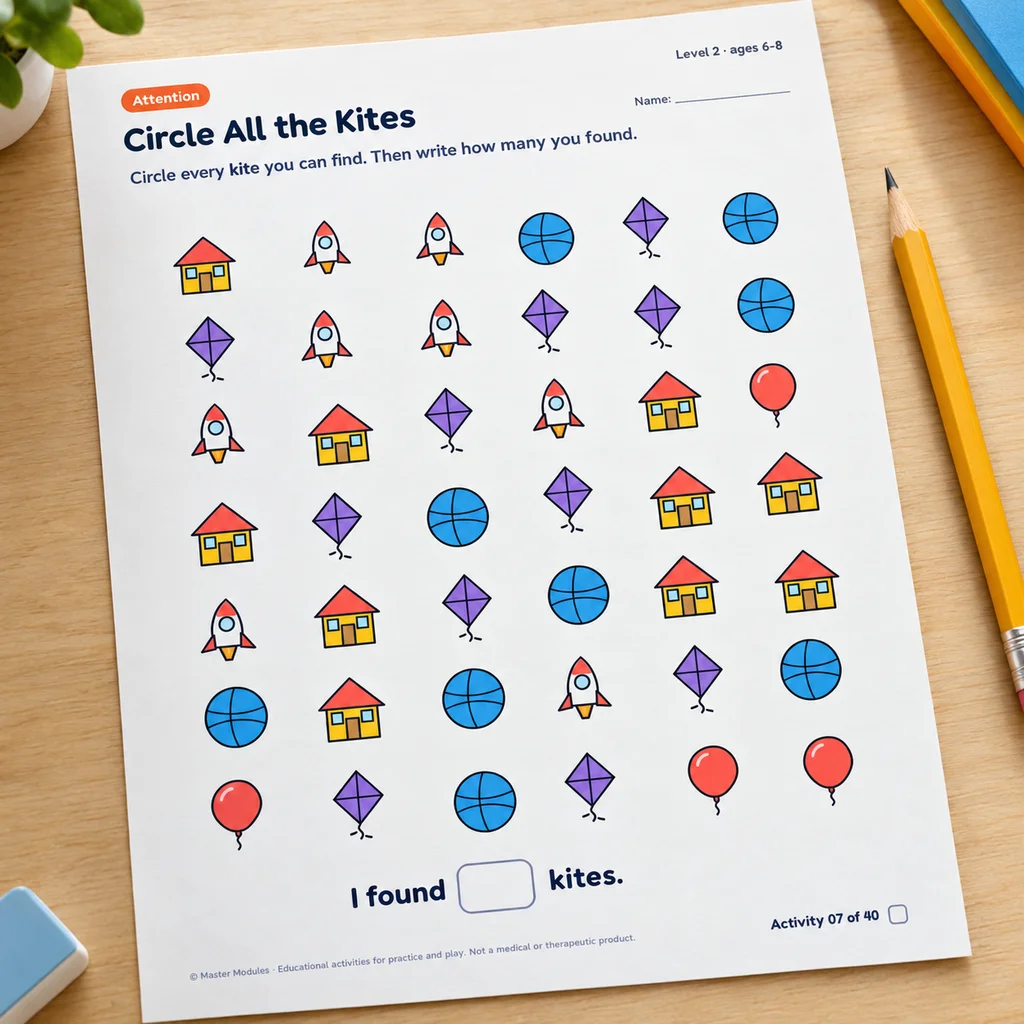
Attention can be practiced directly with games where the whole point is to notice carefully: spot the odd one out, find the matching pair, remember what was on the tray. The key is that it feels like play, not a test.
8. Keep a steady routine
Practice works when it is regular. Ten minutes at the same time each day is more effective than a long session once a week. Children also get more cooperative when the routine is predictable.
9. Celebrate effort, not speed
"You stuck with that maze even when it got tricky" teaches more than "you were fast." Stickers, stars or a certificate at the end of a week make the effort visible without adding pressure.
What a daily focus practice can look like
The simplest version is a 10-minute block with two short activities. Here is a sample for a 7-year-old, using the kinds of pages in the Focus Quest Activity System:
| Time | What happens | Skill |
|---|---|---|
| 0:00 | Stretch and set the timer | Getting ready |
| 0:01 | Odd One Out page | Attention |
| 0:05 | Look, Cover, Remember page | Memory |
| 0:09 | Check answers together, add a star | Finishing |
The system's pages are grouped into seven skills: Attention, Memory, Shapes & Patterns, Logic Sequences, Tracing & Fine Motor, Color by Code and Coordination (mazes, dot-to-dots and tangles). Each of the three levels has 100 activities, so a child can move up as pages get easy. The included 10-Week Routine Planner assigns two activities a day, five days a week, so you never have to decide what to do next.
Things that usually backfire
- Long lectures about concentration. Children rarely absorb them.
- Taking over the task. Staying nearby is fine; doing it for them removes the practice.
- Comparing with siblings or classmates. It adds pressure and makes avoidance more likely.
- Piling on more screen time to "reward" focus. It tends to make the next focus session harder.
For more on screens, see how to reduce screen time without battles.
When to talk to a professional
If your child's difficulty is sudden, getting worse, causing distress, or interfering with school and friendships, talk to your pediatrician or your child's teacher. They can look at the whole picture, including hearing, vision, sleep and learning needs. The activities on this page are for practice and play and are not a medical or therapeutic product.
Next steps
- Pick one change from the list, such as the visible timer, and try it for a week.
- Choose a daily 10-minute slot and protect it.
- Use closed, finishable activities and end each session with a small celebration.
- Look at attention span by age to set realistic expectations, and at the 10-week focus routine plan for a ready-made schedule.