The 6 Syllable Types, With Examples and Teaching Tips
English syllables fall into six types, and the type tells you how to say the vowel. The six are closed, open, magic e (vowel-consonant-e), vowel team, r-controlled and consonant-le. A child who can spot the type of each syllable can decode long words by trying one syllable at a time. This guide defines each type with examples, notes the common exceptions, and shows how to practice sorting them.
Why syllable types help
Long words look scary because they have many letters. But every syllable has exactly one vowel sound, and that sound depends on the shape of the syllable. If a child learns six shapes, they can read rabbit, tiger, cupcake, rainbow, market and table by following the same steps.
The six types at a glance
| Type | Pattern | Vowel sound | Examples |
|---|---|---|---|
| Closed | one vowel + consonant(s) | short | cat, sit, hop, rab-bit, nap-kin |
| Open | ends with a vowel | long (says its name) | me, go, ba-by, ti-ger, ro-bot |
| Magic e | vowel + consonant + e | long | cake, bike, home, mis-take |
| Vowel team | two or more letters make one vowel sound | varies by team | rain, boat, team, cloud, toy |
| R-controlled | vowel + r | changed by the r | car, bird, corn, far-mer |
| Consonant-le | consonant + le at the end | a weak /ul/ | ta-ble, can-dle, ap-ple |
1. Closed syllables
A closed syllable has one vowel and ends with one or more consonants. The consonant closes the vowel in, so the vowel is short: cat, pin, hop, cup, pet. In longer words, rabbit has two closed syllables (rab, bit) and so does napkin (nap, kin).
Exceptions. A few endings break the rule: child, find, kind, gold, bolt, most. These words end in a closed syllable but the vowel is long. Teach them as a small group (ild, ind, old, olt, ost).
2. Open syllables
An open syllable ends in a vowel, so the vowel is not closed in and says its name: he, me, go, hi. In longer words: ba-by, ti-ger, ro-bot, mu-sic, pi-lot, o-pen.
Exceptions. Sometimes the first syllable is closed even though it looks open, as in lem-on, vis-it, riv-er. If a long vowel does not make a real word, try the short one. This "flexing" is a skill worth teaching explicitly.
3. Magic e syllables
A magic e syllable has a vowel, a consonant and a silent e: cake, bike, home, tune. The e makes the vowel long. In longer words: mistake, inside, cupcake. Exceptions include have, give, love. For all five patterns and the jobs of silent e, see the magic e guide.
4. Vowel team syllables
A vowel team syllable has two or more letters that work together to make one vowel sound: rain, boat, team, cloud, toy and raincoat. There are many vowel teams, and some have more than one sound (ea in eat, bread, great). Exceptions: in idea, lion and quiet the vowel letters are in different syllables, not a team. Read more in the vowel teams guide.
5. R-controlled syllables
An r-controlled syllable has a vowel followed by r. The r changes the vowel sound, so it is neither short nor long: car, bird, corn, far-mer, mar-ket, gar-den. Words like fire and hour look r-controlled but include a silent e or a different pattern. See the bossy r guide.
6. Consonant-le syllables
A consonant-le syllable is the last syllable of a word. It has a consonant followed by le, with a weak vowel sound: ta-ble, can-dle, ap-ple, lit-tle, puz-zle, tur-tle. Words like whale and smile are not consonant-le syllables. They are magic e words.
The schwa: the quiet vowel
In a syllable we do not stress, the vowel relaxes into a quiet /uh/ sound called the schwa. It is heard in banana, lemon, pencil, animal, button and circus. Any vowel letter can make it. You cannot tell from the sound which letter to write, so schwa words are learned by sight and by analysis. Teach it as a fact about English, not a failure of the child.
How to teach the types
Start with closed and open. These two give children the two main vowel sounds, short and long, and a first explanation for why rabbit has a short a and tiger has a long i.
Teach one type a week, with a poster, six words and a routine:
- Read the rule aloud.
- Say each example word, tapping the syllables.
- Underline the vowel and say its type.
- Sort a stack of word cards.
Use a "try it both ways" habit. If a child reads lemon with a long e and it does not sound right, they try a short e. This keeps decoding flexible.
A sorting activity
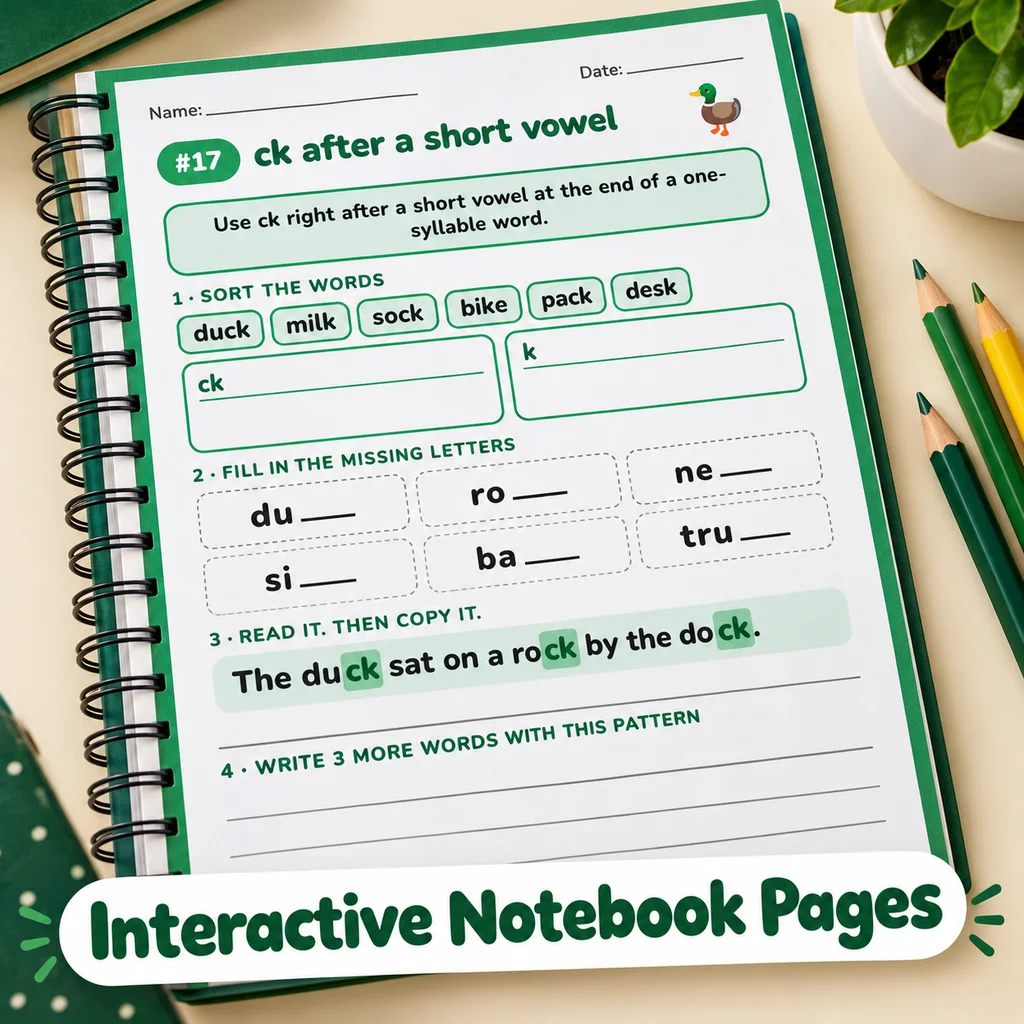
Give pairs of students ten word cards and six labeled mats. Words to include: napkin, tiger, cupcake, raincoat, market, table, rabbit, robot, mistake, garden. Students tap syllables, name the type and place each syllable on a mat. Ask: which syllable type did we meet the most? Which one is hardest to spot?
Where syllable types fit
Syllable types sit between single-syllable phonics and the multisyllable work in grades 2 and up. The next step is learning where to cut a long word, which is covered in the syllable division rules guide. Together they let a child take apart a word like fantastic or hospital in a few seconds.
Posters for the six types
Phonics & Spelling Rules Posters has one poster for each of the six syllable types, one for the schwa, and four for syllable division. Each poster has a plain-language rule, six example words, a contrast and a decodable sentence. They are part of the full set of 130 posters, in color and black & white, in full-page, half-page and mini sizes.