Syllable Division Rules: How to Split Long Words
To split a long word, find the vowels, look at the consonants between them and apply one of four patterns. Two consonants between vowels: split between them (rab-bit). One consonant: split before it first (ro-bot) and, if that sounds wrong, after it (lem-on). And never split a digraph like sh, th, ch or ph. These patterns turn a long word into short pieces a child already knows how to read.
Before you start: mark the vowels
- Write the word: rabbit.
- Underline each vowel (or vowel team): rabbit.
- Look at what sits between the vowels.
The pattern depends on how many consonants are in between.
| Pattern | What sits between | Example | Split |
|---|---|---|---|
| VC/CV | two consonants | rabbit, napkin | rab-bit, nap-kin |
| V/CV | one consonant (try first) | robot, music | ro-bot, mu-sic |
| VC/V | one consonant (second try) | lemon, river | lem-on, riv-er |
| Keep together | digraph or blend | fishing, mother | fish-ing, moth-er |
Pattern 1: VC/CV, split between two consonants
When two consonants sit between two vowels, split between them. The first syllable is closed, so its vowel is short.
- rab-bit, nap-kin, bas-ket, sun-set, pen-cil, muf-fin
Steps:
- Underline the vowels.
- Draw a line between the two consonants.
- Read the first syllable with a short vowel.
- Read the second part and blend.
Pattern 2: V/CV, split before the single consonant
When one consonant sits between two vowels, try splitting before it. The first syllable is open, so its vowel is long.
- ro-bot, mu-sic, pa-per, ti-ger, ba-sic, o-pen
Steps:
- Underline the vowels.
- Draw a line before the consonant.
- Read the first syllable with a long vowel.
- Read the whole word. Does it sound right?
Pattern 3: VC/V, split after the single consonant
If Pattern 2 does not make a real word, move the line. Split after the consonant. The first syllable is closed, so its vowel is short.
- lem-on, riv-er, nev-er, mod-el, cab-in, fin-ish
Teach patterns 2 and 3 as a pair: try long first, then short. The pair is a flexible tool, and children need to learn that their first attempt can be wrong. A sentence to practice: "If it does not sound right, flip it."
Pattern 4: keep digraphs and blends together
Some letters belong together and should not be split:
- Digraphs (sh, th, ch, ph, wh) are never divided: fish-ing, moth-er, kitch-en, dol-phin.
- Blends such as dr, tr, br, pl usually stay together: hun-dred, pump-kin.
Be careful with a few words where letters from two syllables only look like a digraph: mis-hap, up-hill. These are compound-like words where the s and h belong to different parts, and they are real exceptions.
A reading routine for long words
Give children a five-step routine:
- Look for the vowels and underline them.
- Look between the vowels and count the consonants.
- Divide using the pattern.
- Read each syllable, using its syllable type to choose the vowel sound (see the syllable types guide).
- Blend the syllables and ask: is it a real word?
If it is not, try the other split (V/CV or VC/V) and read again.
Words with endings and compounds
- Compound words split between the two small words: sun-flower, cup-cake, rain-bow.
- Prefixes and suffixes are usually separate syllables: un-happy, re-play, help-ful.
- Doubled consonants after a short vowel split in the middle: hop-ping, run-ning. (This links to the doubling rule.)
- Consonant-le words keep the consonant with the -le: ta-ble, ap-ple, can-dle. Where two consonants come before the -le, split between them (VC/CV).
Practice ideas
- Cut and sort. Print words on strips. Students cut at the division line and sort by pattern.
- Tap and say. Say a word, tap the syllables on the desk and state the pattern.
- Flip game. Show a word with a single consonant between vowels. Students try both splits and vote on the real word.
- Chunk bingo. Call a syllable. Students find a word card that contains it.
Where this fits in the sequence
Syllable division is for students who already know the six syllable types and the basic vowel patterns. It works best after closed and open syllables, magic e, vowel teams and r-controlled vowels are in place. With those pieces, a child can read a word like fantastic, pumpkin or hospital by dividing and decoding. See the r-controlled vowels guide for one set of patterns that often sit inside long words, and the full list of spelling rules for the entire sequence.
Four posters for the four patterns
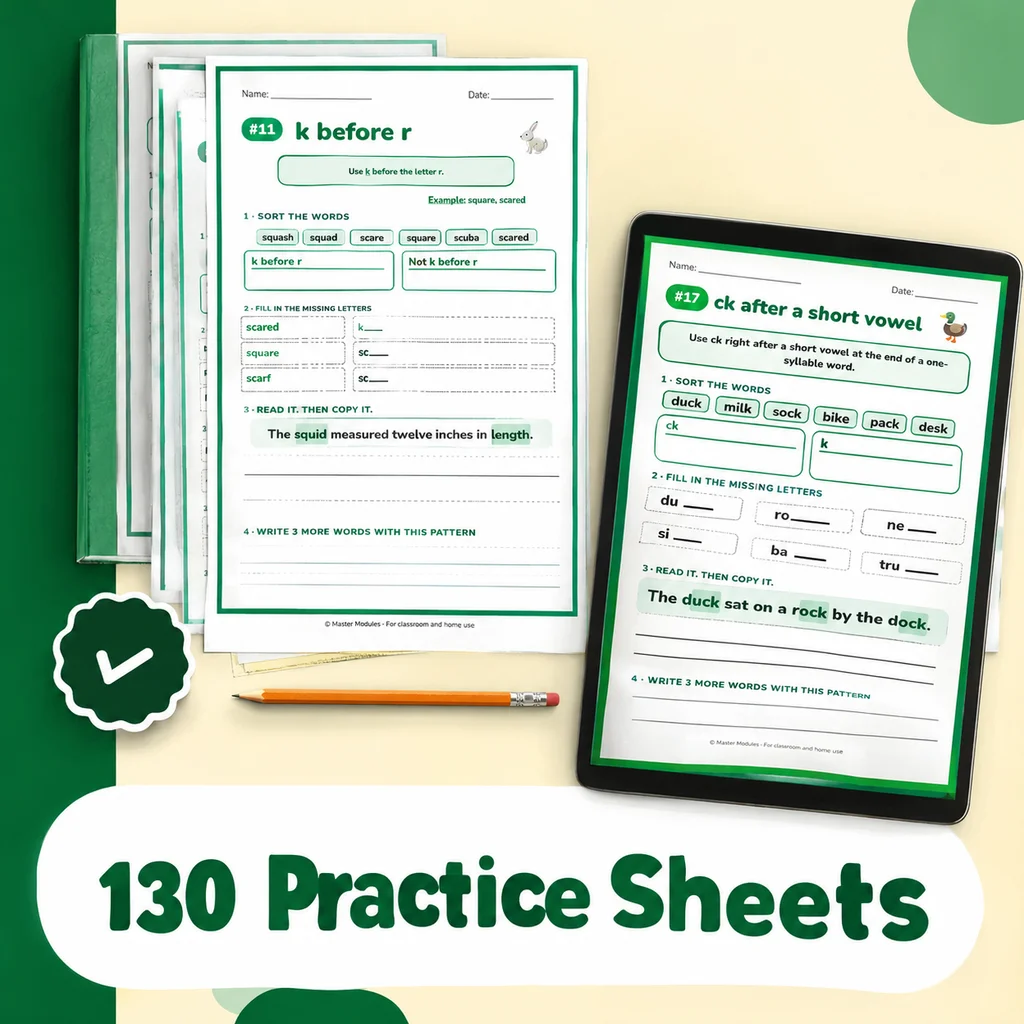
Phonics & Spelling Rules Posters has one poster for each division pattern in this guide: VC/CV, V/CV, VC/V, and keeping blends and digraphs together. Each has a plain-language rule, six example words, the real exceptions and a decodable sentence. They sit alongside the six syllable type posters and the schwa poster in the full set of 130, in color and black & white, in full-page, half-page and mini sizes.