Sequencing and Pattern Worksheets: How to Use Them by Age
Sequencing worksheets ask a child to put things in order or find the rule; pattern worksheets ask them to notice what repeats and continue it. Both train the same habit: look carefully, spot the rule and apply it. This guide explains the common types, shows simple examples for each age, and gives a step-by-step way to build up from objects to printed pages.
Patterns vs. sequences
| Pattern | Sequence | |
|---|---|---|
| What it is | Something that repeats | Things in an order that follows a rule |
| Example | Circle, square, circle, square | 2, 4, 6, 8 or small, medium, big |
| What the child does | Continue it | Order it or find the missing item |
Everyday life is full of both: stripes on a shirt, the days of the week, the steps for brushing teeth, the order of a story.
Types of worksheets, with examples
The Focus Quest Activity System includes two relevant skill groups: Shapes & Patterns (42 activities across three levels) and Logic Sequences (42 activities). Here are the types you will see, and what each asks of a child.
Pattern types
- Keep the Pattern Going. A row of shapes or colors repeats; the child draws what comes next.
- Grid patterns. A pattern appears in a grid, and the child completes the missing squares.
- Shadow match. The child matches a shape to its silhouette.
- Turn and match. At Levels 2 and 3, the child finds which shape is the same one rotated.
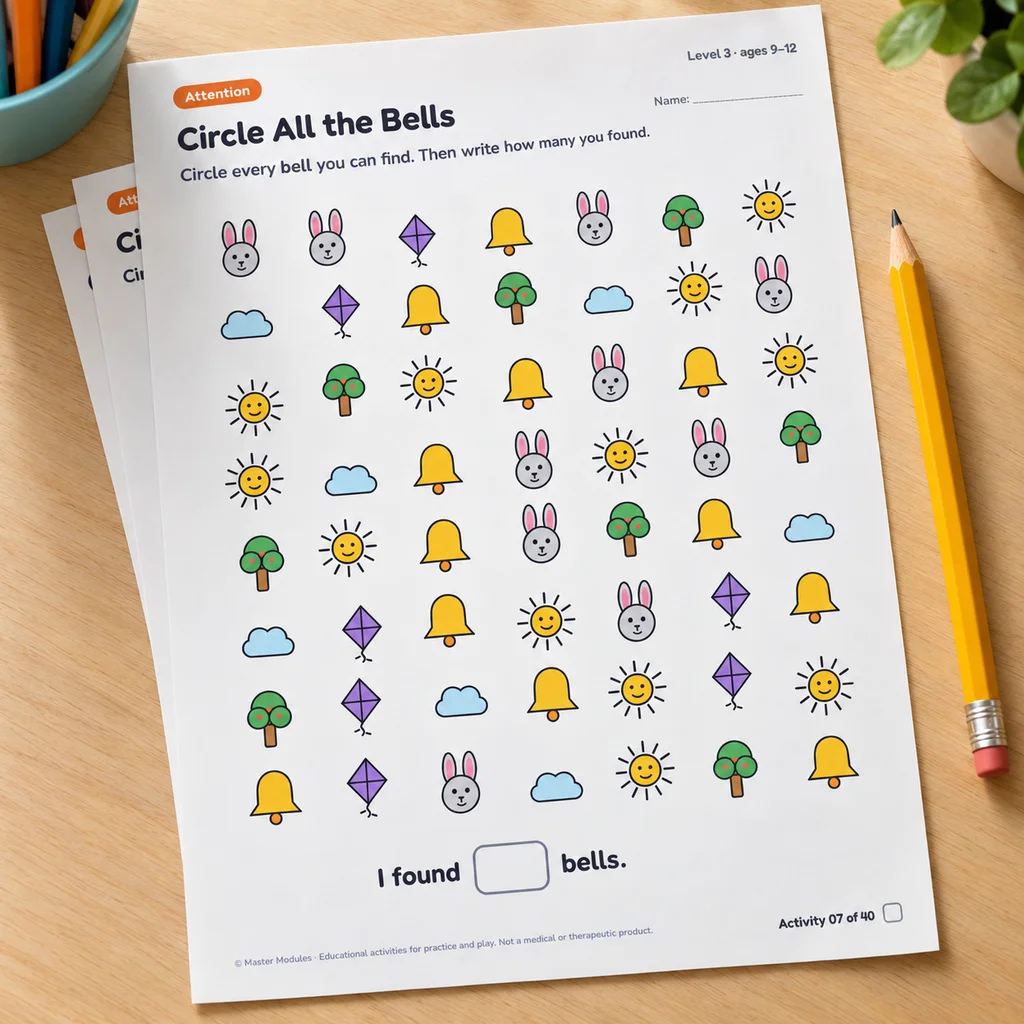
- Shape count. The child counts how many times a shape appears.
Sequence types
- Small to Big. The child orders objects by size (a Level 1 activity).
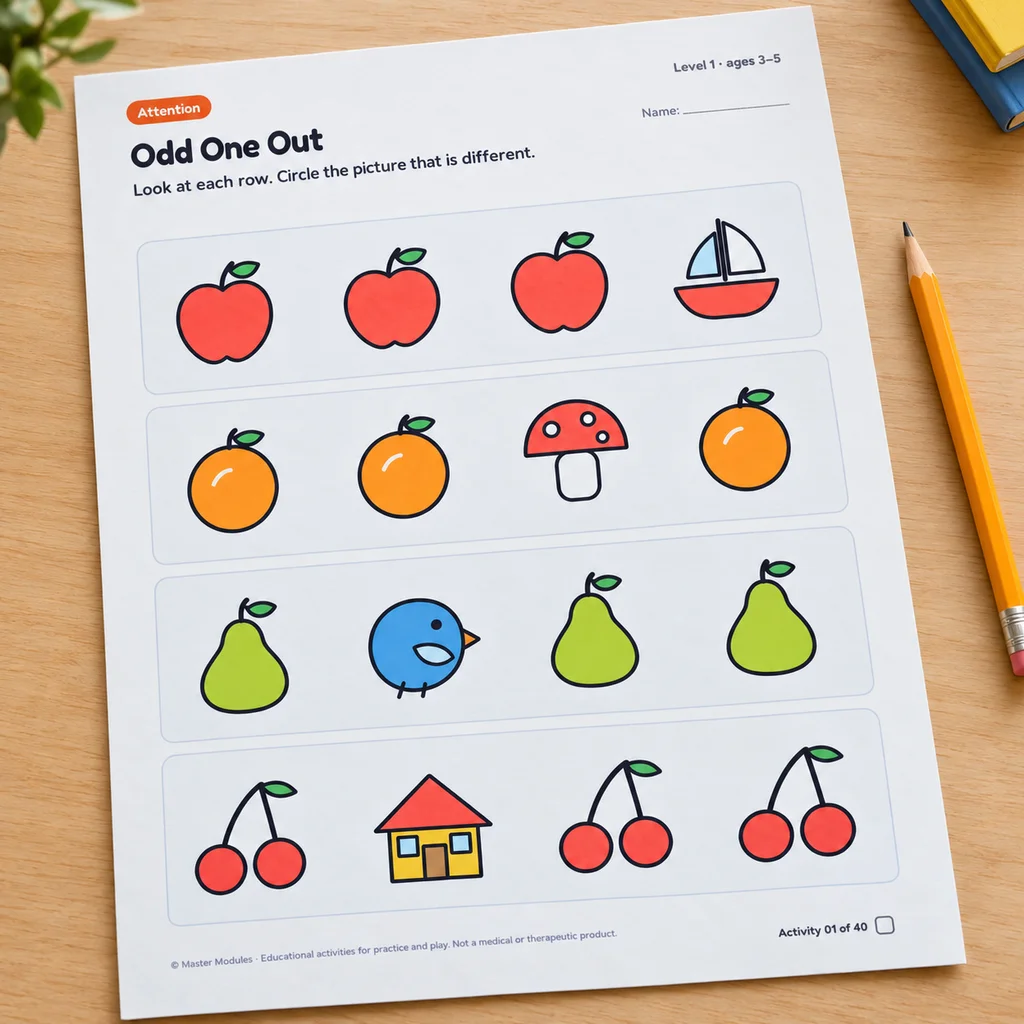
- Which One Does Not Belong? The child finds the odd one out in a category.
- Sort it. The child places items into groups.
- Number sequences. The child fills in the missing number, often by counting on or skipping.
- Matrix puzzles. A grid of pictures follows a rule across rows and columns.
- Shape math. At Levels 2 and 3, shapes stand for numbers and the child works out the value.
How to build up, step by step
- Start with real objects. Lay out colored blocks or coins and continue a simple pattern. Say it aloud: "red, blue, red, blue…"
- Move to drawn patterns. Let the child draw the next shape.
- Add a third element. Move from AB patterns to ABC and AAB.
- Introduce numbers. Counting on by 1, then by 2, 5 and 10.
- Ask for the rule. "What is changing?" turns a worksheet into a thinking game.
- Create their own. Have the child make a pattern for you to solve.
What to expect at each age
These are starting points, not norms. Children vary.
| Age band | Start with | Move toward |
|---|---|---|
| 3 to 5 (Level 1) | Continue an AB pattern; order three sizes; sort by one feature | Grid patterns; number order 1 to 10 |
| 6 to 8 (Level 2) | ABC patterns; missing numbers; turn-and-match | Shape math with small numbers; matrix puzzles |
| 9 to 12 (Level 3) | Skip-count sequences; rotation puzzles; harder matrices | Shape math with larger values; creating puzzles for others |
A sample 10-minute session
| Minutes | Activity | Skill |
|---|---|---|
| 0 to 5 | Keep the Pattern Going page | Shapes & Patterns |
| 5 to 10 | Number sequence page | Logic Sequences |
In the system's 10-Week Routine Planner, activities are mixed so that a pattern page is followed by a different skill, such as memory or tracing. Each level has 14 pattern pages and 14 logic pages, so there is plenty to work through before a format repeats. An Answer Key Book with all 300 solutions makes checking quick.
Quick games that build the same skills
Worksheets are not the only way. These Screen-Swap Cards in the system use the same idea without paper:
- Pattern Spotting: find patterns in stripes, tiles or book spines and say the repeating part aloud.
- Pack the Picnic: add an item to a growing list and repeat it in order.
- Skip-Count Hop: hop once for each count by 2, 5 or 10.
- Story Chain: retell the story so far, then add a sentence, which practices putting events in order.
Try one of these before a worksheet to warm up, and the page will often go faster.
Questions parents ask
My child guesses instead of finding the rule. Ask "what comes next, and how do you know?" The explanation matters more than the answer.
My child finishes too quickly. Move up a level, ask for a second rule, or have them invent a pattern for you to solve.
My child gets frustrated. Go back to real objects such as blocks and buttons, then try the page again.
Making worksheets more engaging
- Use color. Let the child color the pattern as they complete it.
- Say it out loud. Reading the pattern aloud reveals the rule.
- Beat the clock gently. Use a timer to see how many finish in 10 minutes, not to race.
- Reward effort. The Celebration Pack includes printable stickers and certificates.
- Mix the skill. A pattern page between a maze and a memory game keeps interest high.
Reading a page with your child
Before they start, look at the page together for ten seconds. Ask "what do you notice?" and let the child point at the repeating part or the first number. This short pause is often the difference between guessing and finding the rule, and it takes almost no time.
Where this connects
Sequencing and counting are the foundation of early number sense. See preschool math worksheets for what early math practice looks like. For pencil control, see fine motor activities for preschoolers, and for more on maze difficulty, see printable mazes by age.
These are educational activities for practice and play, not a medical or therapeutic product.