Printable Mazes by Age: How to Pick the Right Level
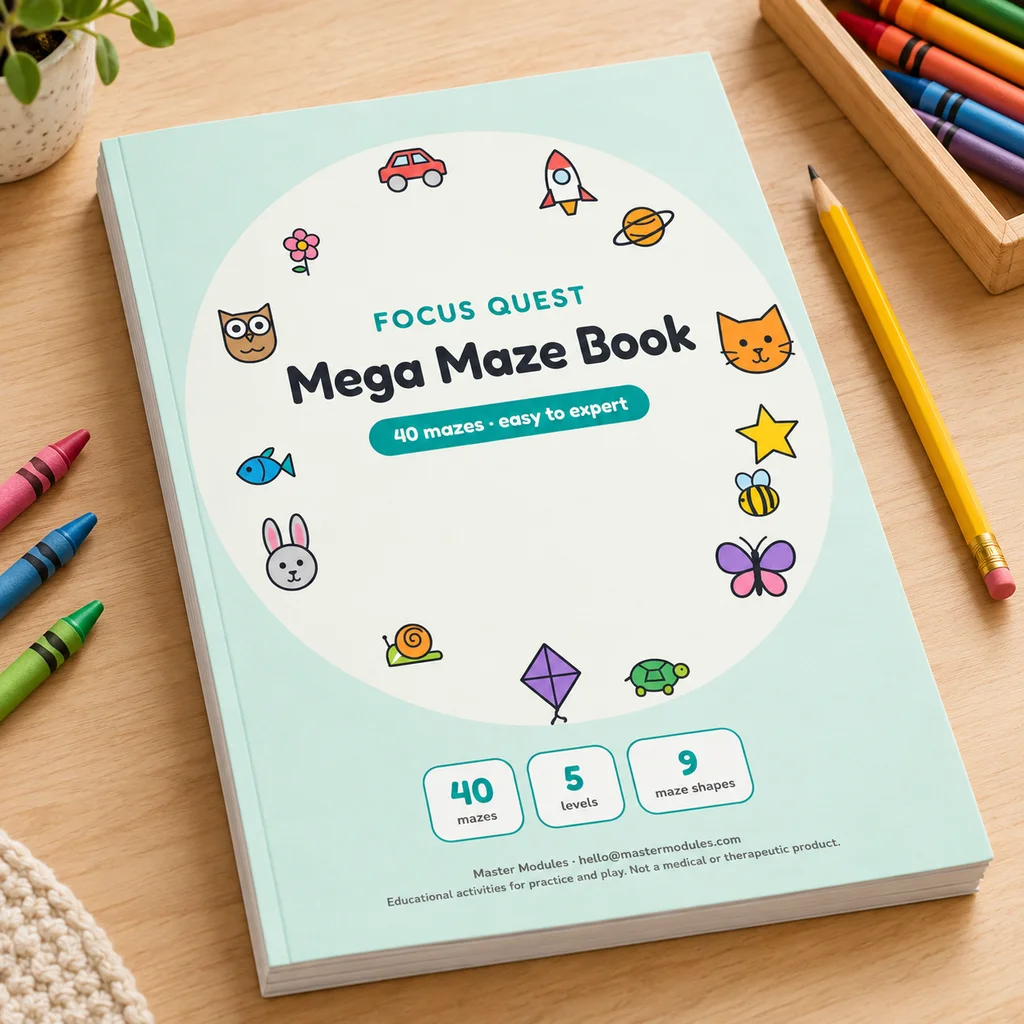
Match a printable maze to your child's age by looking at four things: grid size, path width, number of dead ends and how much pencil control it needs. A three-year-old does best with a short maze, wide paths and one obvious route. A ten-year-old can handle a large grid with many branches. This guide explains how to pick, how to build up, and what mazes practice.
What mazes practice
A maze looks simple, but it asks a child to do several things at once:
- Plan ahead. Looking at the path in front and picking the likely route.
- Control the pencil. Staying inside the lines is fine motor practice.
- Notice and recover. Hitting a dead end and trying a different route builds persistence.
- Stay with a task. A maze has a clear start and finish, which makes it a good short focus exercise.
Mazes are one enjoyable way to practice these skills, not a treatment for anything. They work best as part of a mix with other activities.
What makes a maze easy or hard
| Feature | Easier | Harder |
|---|---|---|
| Grid size | 5 × 5 or smaller | 20 × 20 or larger |
| Path width | Wide, enough for a thick crayon | Narrow, needs a sharp pencil |
| Dead ends | Few, short | Many, long |
| Decision points | One or two clear forks | Many forks, similar-looking paths |
| Theme | Large picture with a character | Plain, abstract |
| Starting help | Arrow or a colored path | None |
Mazes by age
Ages 3 to 5
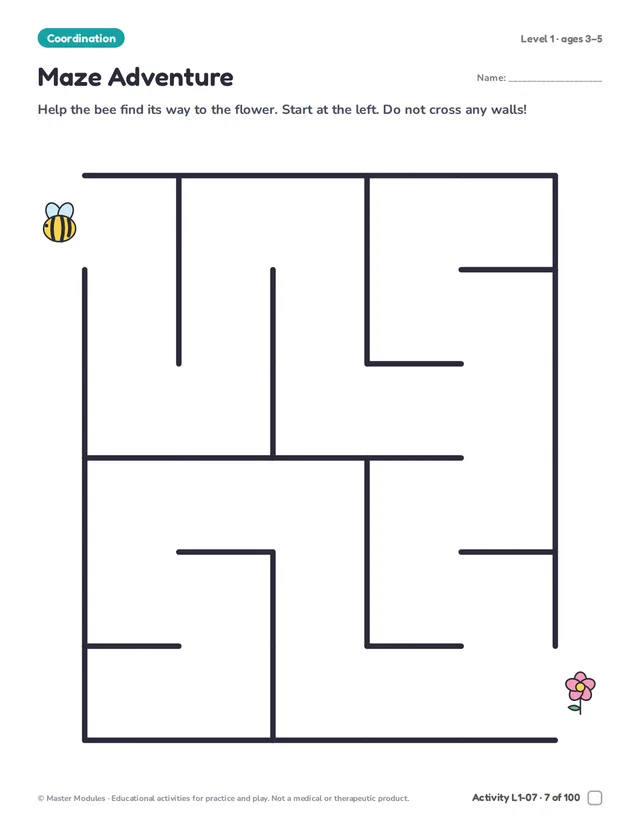
Start with finger tracing, then move to a thick crayon. Choose mazes with big openings and one or two choices. Praise finishing, not neatness. In the Focus Quest Activity System, Level 1 (ages 3 to 5) includes 6 mazes alongside 6 dot-to-dot pages and 3 tangle pages. They start easy and get harder through the level.
Ages 6 to 8
This is the stage where most children can handle a pencil and a medium maze. Look for mazes with a few dead ends and ask the child to say where they will go before they start. Level 2 (ages 6 to 8) has 6 mazes, 6 dot-to-dot pages and 3 tangles.
Ages 9 to 12
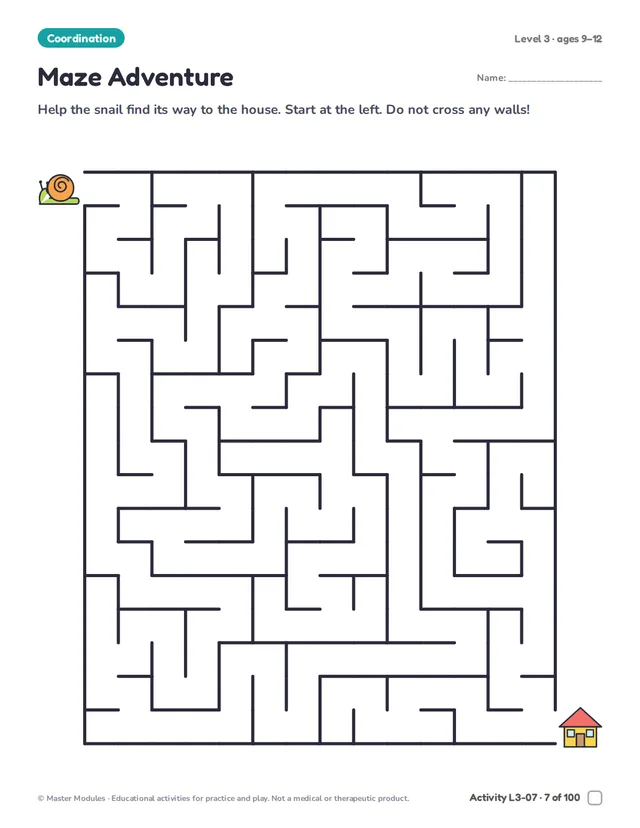
Older children enjoy a challenge. Choose bigger grids with more branches, or time themselves (against the clock, not each other). They can also try drawing a maze for someone else, which is a great logic exercise. Level 3 (ages 9 to 12) includes 6 mazes, 6 dot-to-dots and 3 tangles, pitched at the oldest age group.
Within each level, mazes sit in the Coordination group, which has 15 of the level's 100 activities. The rest of the level is spread over six other skills, so children get variety and do not tire of one type. In total, the three levels hold 18 mazes, 18 dot-to-dot pages and 9 tangle pages.
How to use mazes well
- Start with a finger. Even older children can trace first to plan.
- Say the route aloud. "I'll go right, then up" strengthens planning.
- Use the Answer Key. The Answer Key Book in the system shows each solution, so you can check or help without guessing.
- Keep sessions short. One or two mazes in a 10-minute block is plenty.
- Mix it up. Follow a maze with a different skill, such as a memory game or a pattern page.
A sample 10-minute session
| Minutes | Activity | Skill |
|---|---|---|
| 0 to 5 | One maze | Coordination, planning |
| 5 to 10 | Pattern page or odd-one-out | Shapes & Patterns or Attention |
The system's 10-Week Routine Planner assigns two activities a day for five days a week. That means a child sees a maze, a dot-to-dot or a tangle regularly, without you having to plan it.
Fresh mazes on demand
The Focus Quest web app includes a Maze Maker tool that makes new printable mazes with solutions, useful when a child wants "just one more." The web app has six tools in total: Focus Timer, 10-Week Routine, Maze Maker, Find & Circle, Stars & Rewards and Memory Game.
Common questions about maze practice
Should we use the answer key right away? Let your child try first. If they are stuck after a few minutes, trace the first few turns together and let them continue, then use the answer key to confirm.
What if my child cheats by drawing through walls? That is normal for young children. Gently say "let's find the path" and go back to finger tracing. Cheating usually fades once the maze stops feeling like a puzzle they cannot solve.
Can we make a maze ourselves? Yes. Older children often enjoy drawing a maze for a sibling: start from the exit and work backward, then add false turns. It is a surprisingly good planning exercise.
What if the maze is too easy? Move up a level, time it for fun, or ask the child to find a second route.
Printing and pencil tips
Print mazes on plain paper at full size; shrinking them makes the paths too narrow for small hands. Use a soft pencil with a good eraser for older children and a thick crayon for younger ones. Taping the page to the table keeps it from sliding, which is a small change that makes a big difference to control.
Beyond mazes
Mazes are one of seven skill groups. Children also benefit from tracing, patterns, memory and sequencing. For pencil-control ideas, read fine motor activities for preschoolers. For logic and patterns, see sequencing and pattern worksheets. To see what fits each age, see printable activities by age.