Math Puzzles With Answers: What a Trustworthy Answer Key Looks Like
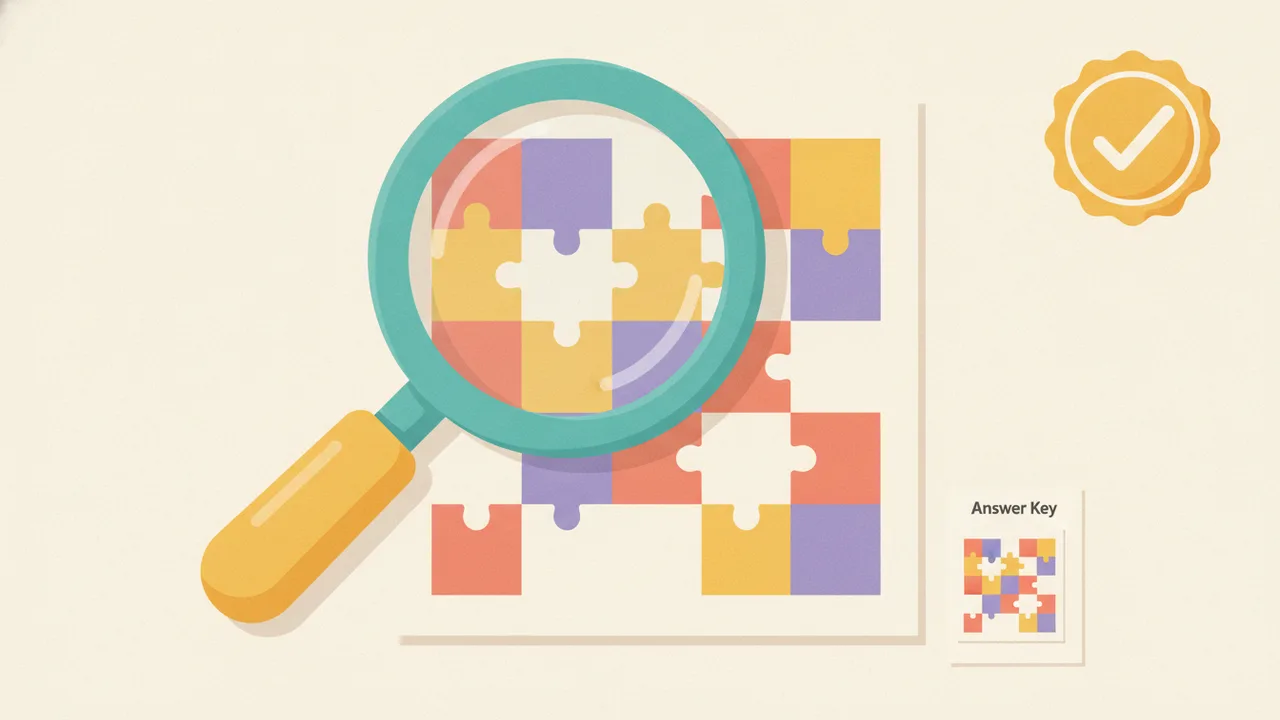
A math puzzle with answers is only useful if the answer is actually the only one. When a puzzle can be solved more than one way, the answer key is a guess about which one the author had in mind, and a child who solved it correctly may be marked wrong. That is a quick way to lose a child's trust in math.
This page explains what to look for in an answer key, how verification works in practice and how to use a key so kids learn from it.
What can go wrong with answer keys
| Problem | What it looks like |
|---|---|
| More than one valid answer | A child finds a solution that fits every clue but differs from the key |
| No valid answer | The key shows a result, but the clues contradict each other |
| Typos in the key | One number in the key is simply wrong |
| No working shown | The key gives the result but no way to see where a mistake happened |
Any of these can turn up in a set that was assembled without checking. If you have ever worked a puzzle for ten minutes and got stuck on a contradiction, you have met one.
What "one verified answer" means
A trustworthy puzzle goes through a check like this:
- Generate the puzzle with its intended solution.
- Solve it again from scratch with a separate solver that does not know the intended solution. The solver searches exhaustively and returns every valid answer.
- Accept the puzzle only if the solver finds exactly one answer and it matches the intended one.
- Discard it otherwise and generate a new one.
This independence matters. If the same code both makes and checks the puzzle, a mistake in the logic can pass unnoticed. A second program that reasons its own way is a real test.
How it is done in PuzzlePath Math Puzzle Pack
Each of the 350 puzzles in the pack is generated by script and checked by a separate solver that does not read the intended solution. A puzzle is kept only if the solver finds exactly one answer and it matches. The check is run again on the saved puzzle data before the books are built. The result is a set where the key is a fair judge: if a child's answer differs, the difference points to a real slip.
Every book also ends with an answer key showing four solved puzzles per page, drawn the same way as the puzzle so a child can compare directly.
How to use an answer key well
For kids
- Finish first. Complete the puzzle before looking.
- Compare the whole puzzle, not just one number.
- If something differs, find the first place it does. Ask, "What would I need to change to get the key's number?"
- Fix it and try again before moving on.
For grown-ups
- Keep the key separate (a different folder or the last pages) so it is not tempting mid-puzzle.
- Do not just say "wrong." Ask the child to show their first step and look for the slip together.
- Celebrate fixes. Finding and correcting a mistake is a skill worth naming.
Self-checking without a key
Some puzzle types check themselves, which is useful when a key is not nearby:
- Arrow diagrams: when two arrows land in the same box they must agree.
- Number pyramids: every brick must be the sum of the pair below.
- Equation grids: each number must satisfy both the row and the column it sits in.
- Mazes: a dead end tells you to back up.
Teaching kids these checks is as valuable as the key.
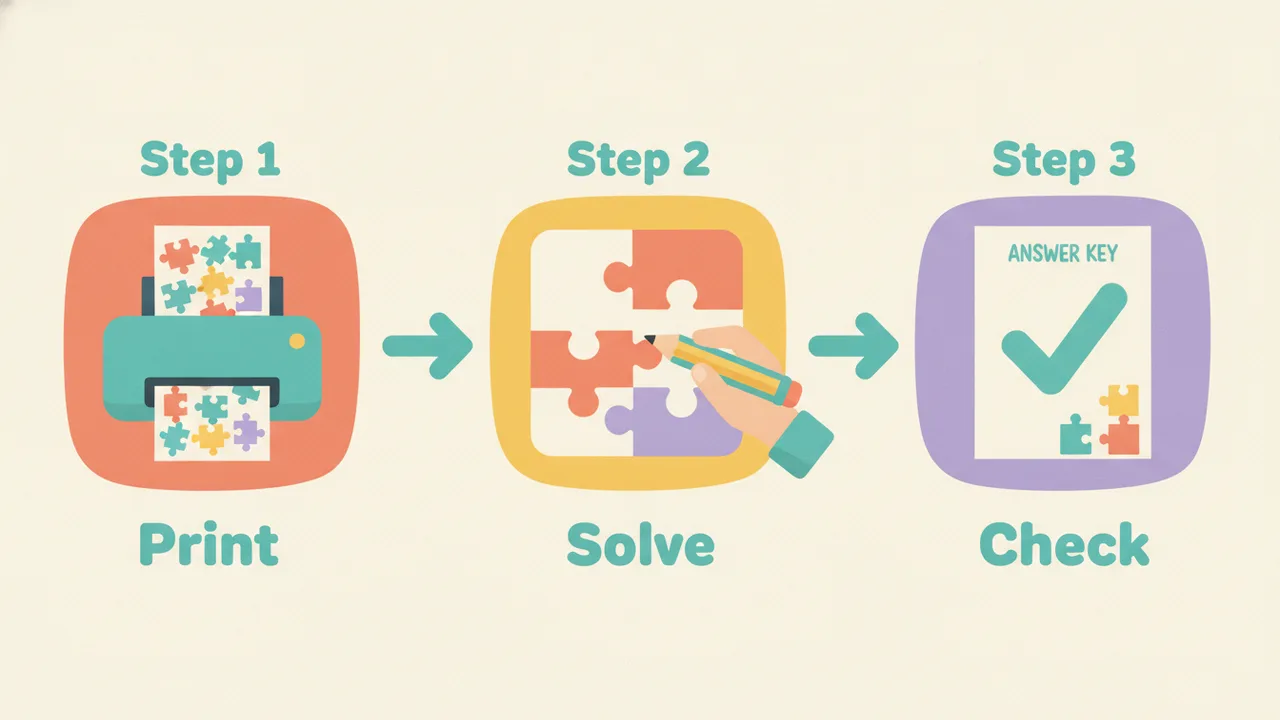
Answer keys and the classroom
An answer key changes how a classroom runs. With a trustworthy one:
- Early finishers can check their own work, so you are free. See math early finishers.
- Warm-ups can be checked in under a minute. See math warm-ups and bell ringers.
- Homework can be self-corrected.
What to look for when buying puzzles
- A clear statement of how answers were verified.
- Solutions drawn on the same grid, not just a list of numbers.
- A worked example of how each puzzle type works.
- Levels, so a child who is stuck can step down.
For a tour of the puzzle types themselves, see printable math puzzles: 7 types. For quick reasoning warm-ups with clean answers, see math brain teasers for kids.