Math Is Boring: Why Kids Say It and How to Make Math Fun
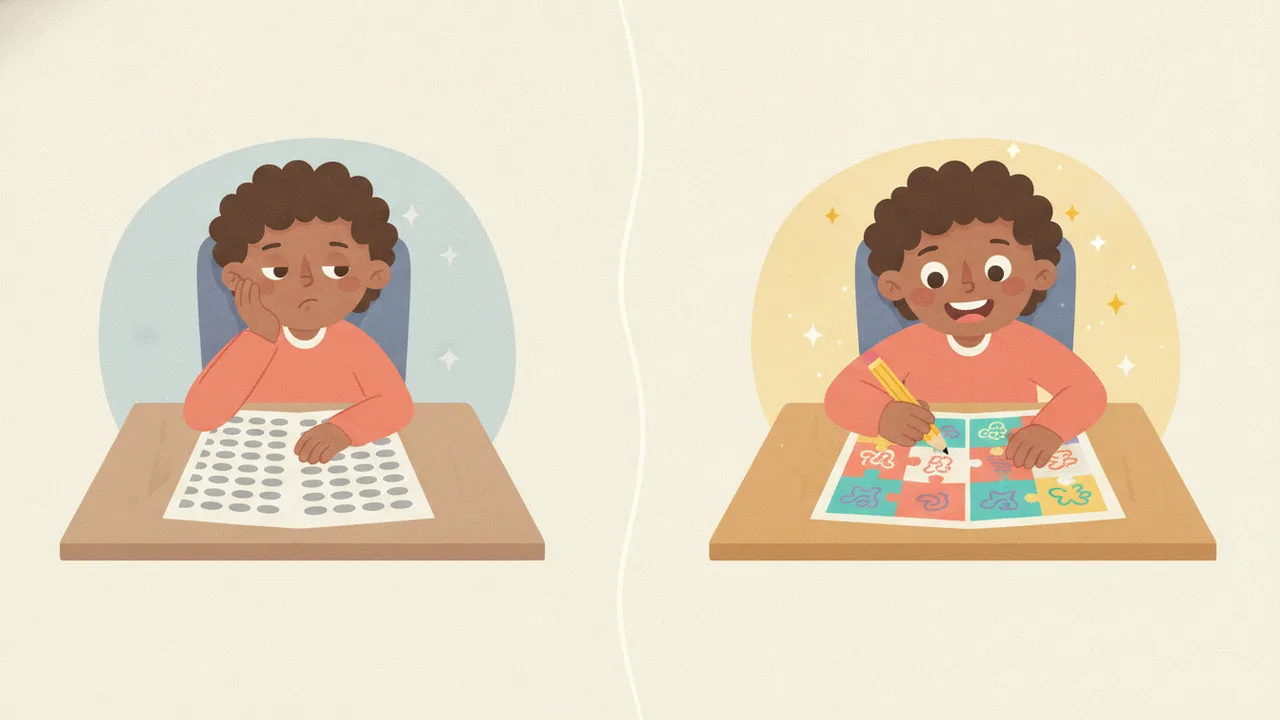
When a child says "math is boring," they rarely mean the numbers. They mean the experience: the same fifteen problems in a row, no sense of where it is going, and no way to tell whether they are getting better. The good news is that all three can be changed without lowering the standard of what they practice.
This guide covers the three reasons kids tune out, how to tell which one you are dealing with, and a simple routine that turns practice into something they ask to do.
The three kinds of boring
"Boring" is a label kids use for several different problems. Watch what happens right before the complaint.
| What you see | What is probably going on | What helps |
|---|---|---|
| Rushes through, makes careless mistakes, sighs | The work is too easy and repetitive | A bigger challenge, not more of the same |
| Stalls on the first problem, says "I can't" | The work is too hard and feels like failing | A smaller first step and a quick win |
| Does it fine but asks "why are we doing this?" | No purpose beyond finishing the page | A goal that is not "get the answer" |
Most kids drift between all three in a single week. The fix in each case is to change the shape of the task, not to lecture about why math matters.
Why worksheets lose kids
A worksheet of twenty similar problems asks the same question twenty times. Once a child understands the method, problems two through twenty are just effort. Nothing new is learned and nothing feels like progress, which is what boredom actually is.
A puzzle changes that. In a good puzzle:
- There is one goal that is not "finish the page": reach the end, open the lock, fill every brick.
- Each answer unlocks the next step. The child gets a small reward after every correct move.
- The check is built in. If the numbers do not fit, they know something is wrong without anyone telling them.
- The skill is hidden in the goal. Kids add and subtract to solve the puzzle, not to practice adding.
Five changes that work
1. Swap the format, keep the skill
If a child can already do addition and subtraction facts, the next page of them is the problem. Put the same facts inside a puzzle where a wrong answer breaks the next step. The arithmetic is identical; the experience is not.
For example, in a path puzzle you start at a number and apply each step in turn: start at 8, add 5 to get 13, multiply by 2 to get 26, subtract 6 to get 20, divide by 4 to get 5. Five facts in a row, and the last number only works if every one before it was right.
2. Make the level fit the child, not the grade
A child who is a little ahead gets bored on grade-level work. A child who is a little behind gets discouraged. Use a set that has more than one level and let the child move up when it feels easy and back down when it does not. Graded puzzle books that run from Easy to Hard in the same volume let you do this without buying a new book every time.
3. Keep sessions short and predictable
Ten minutes after dinner or before screen time is easier to keep than a long session. Stop while the child still wants one more. That one more is what you are building.
4. Let them check their own work
Nothing kills motivation like waiting for a grown-up to mark a page. An answer key at the back lets the child check a finished puzzle alone. When every puzzle has exactly one solution, the key is also a fair judge: if their answer differs, one of the two is wrong, and they get to find out which.
5. Show progress they can see
Kids care about progress more than they let on. A simple tracker with one box per puzzle, with the date and time written in, shows a growing row of finished boxes and a falling time. That is a better argument for practice than anything you could say.
What a "fun" puzzle set should contain
Not all puzzle sets are equal. Before you pick one, check for:
- More than one type of puzzle. One format gets stale in a week; seven keeps the novelty going.
- Real levels, not a single difficulty with a label on it.
- A worked example that shows how each game works, so the child can start without a grown-up.
- An answer key, ideally one where every puzzle has a single answer.
- No prep. If you have to build it, you will not do it on a tired Tuesday.
PuzzlePath Math Puzzle Pack was built around that list. It has seven different games (Snake Math, Cross Math, Honeycomb Math, Math Flow, Crack the Code, Number Pyramid and Math Mazes) with 50 puzzles in each. Every book moves from Easy to Medium to Hard, and each has a "How to play" page with a worked example and an answer key. The games between them practice addition, subtraction, multiplication and division without a single page that looks like a drill.
A simple ten-minute routine
- Pick the puzzle together. Choice is half of buy-in. Offer two games and let them point.
- Read the "How to play" example once, or let them read it. Do not explain more than it does.
- Set a timer for ten minutes and leave them alone with it.
- Check against the key when they finish, not before.
- Write the time in the box and tick it off.
- Stop. Do not add "one more for practice."
If they ask for another one, say yes. That is the whole point.
When "boring" means something else
Sometimes the complaint is not about the format. If a child is truly stuck on a concept such as fractions or place value, no puzzle will fix that on its own, and the frustration can read as boredom. Go back to the idea behind the problem and rebuild it with objects or drawings first. Talk to the teacher if the struggle is persistent.
Where to go next
For more ideas that keep practice interesting, see math brain teasers for kids for quick logic starters, math enrichment at home for a longer-term plan, printable math puzzles for the seven types explained, and early finishers math if the problem shows up in a classroom.