Math Fact Fluency Games: Practice All Four Operations With Puzzles
Fluency comes from many repetitions of the same facts, and the main challenge is keeping a child willing to do them. A fluency game wraps repeated facts in a goal so each repetition is part of finding something out. The facts are the same; the child's attitude is not.
This page explains what to look for in a fluency game, which printable puzzle types give the most repetition of each operation and how to run short sessions.
What makes a good fluency game
| Feature | Why it matters |
|---|---|
| Many facts per puzzle | Repetition is the point |
| Facts are needed, not decorative | A wrong fact breaks the puzzle |
| Immediate feedback | The child sees at once whether it fits |
| Levels | Facts get harder as the child improves |
| Short | A puzzle should take minutes, not an hour |
Which operations each game drills
The table shows which operations each game uses at each level, from the game rules in PuzzlePath Math Puzzle Pack.
| Game | Easy | Medium | Hard |
|---|---|---|---|
| Snake Math | + and − | adds × and ÷ | all four |
| Cross Math | + and − | + − × | all four, two per sentence |
| Math Flow | + and − | adds × | all four |
| Crack the Code | + | + − × | all four |
| Number Pyramid | + and − | + and − | + and − |
| Honeycomb Math | + and − (sums) | + and − (sums) | + and − (sums) |
| Math Mazes | multiples | calculations | calculations and patterns |
A quick summary: for addition and subtraction facts, use Number Pyramid and Honeycomb Math. For multiplication and division, use Snake Math, Math Flow and Cross Math at Medium and above. For all four together, Hard Snake Math and Math Flow.
Why these work as fluency practice
Snake Math
A path puzzle applies one fact after another. A Medium puzzle has 18–24 steps, so it is 18–24 facts in a single page, and each depends on the one before. A slip at step 6 shows up at step 7. It is exactly the repetition fluency needs, and the dependency makes the child want to get each right.
Math Flow
Arrows carry operations between boxes. When two arrows land in the same box, both must give the same number, which is a built-in check for each fact. At Hard, some boxes can only be found by running an operation backward, which builds the link between multiplication and division.
Cross Math
Equations cross, so one answer feeds another sentence. It drills the inverse relationships: knowing 6 + □ = 15 means knowing 15 − 6.
Number Pyramid and Honeycomb Math
Both practice addition and subtraction facts, with sums that stack up. Honeycomb Math also builds number sense around combinations of digits.
A ten-minute session
- Pick a game and level where most facts are quick.
- Set a timer for ten minutes, or none.
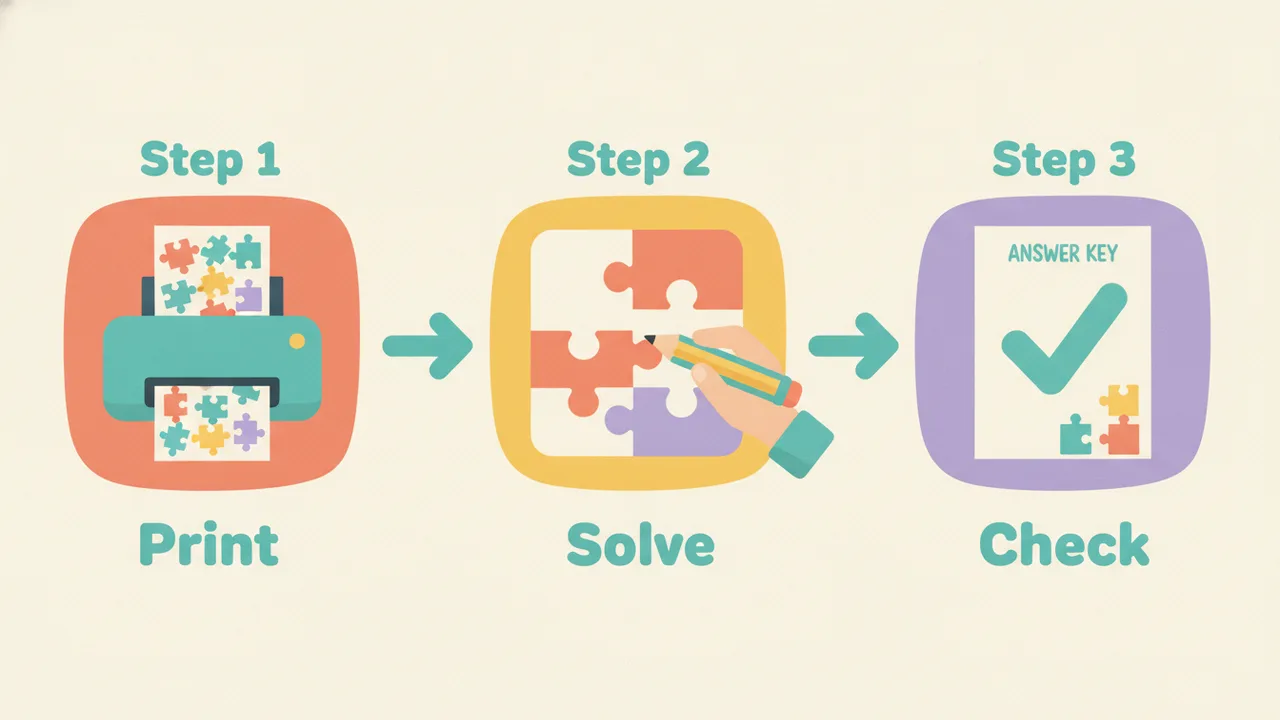
- Solve one puzzle, then check with the key.
- Note the time in the box.
- Do a second puzzle only if the child asks.
A weekly plan by operation
| Day | Focus | Game |
|---|---|---|
| Mon | Addition and subtraction | Number Pyramid |
| Tue | Multiplication | Snake Math (Medium) |
| Wed | Division and inverse | Math Flow |
| Thu | Mixed | Cross Math |
| Fri | Child's choice | Any |
Build accuracy first, speed second
Fluency has two parts: knowing the answer and knowing it quickly. Accuracy comes first. If a child gets facts wrong at speed, they practice mistakes. A good routine is:
- Do the puzzle untimed.
- Check it.
- Do a similar puzzle a few days later and write the time.
- Look at the times across the week.
A simple tracker with space for the date and time makes this easy, and every book in PuzzlePath Math Puzzle Pack includes a 50-box tracker page.
Fluency in the classroom
Fluency games fit into a center rotation, a warm-up or an early-finisher folder. Pair them, one solver and one checker, then swap. See math warm-ups and bell ringers for starters. Levels are a guide to difficulty, not a promise about a grade: Easy is written for grades 3–4, Medium for 5–6 and Hard for 7–8.
What the pack does and does not do
The puzzles give many repetitions in a goal-driven format, with a worked example and a verified single answer for each. They are not a diagnostic test and they do not replace a teacher's judgment about which facts a particular child still needs to learn. If a child is shaky on a particular fact family, pair the puzzles with some targeted recall practice.
More to explore
For practice on the order-of-operations rule, see the order of operations game. For grade-by-grade guidance, read math puzzles for 3rd to 6th graders. For classroom-ready options, see printable math games with no prep.