Waiting Room and Restaurant Activities for Kids (Quiet, No Screens)
The best waiting room and restaurant activities are quiet, need almost nothing, and can be started in seconds. Below are 12 ideas that work for ages 3 to 12 using only eyes, hands, paper and a pencil. Each has a quick way to make it easier or harder, so you can keep a child busy even when the wait is longer than expected.
Why waiting is hard for kids
Waiting asks a child to do something young children are still learning: be still and occupied with no clear end. Add a new place, nothing familiar to play with, and an adult who is also on edge, and a meltdown can arrive quickly. The fix is not a longer list of rules but a few short games you can start without setup.
Pack a small "waiting kit"
A pencil case or zip bag is enough:
- Two pencils and a few crayons
- A few sheets of paper or a clipboard
- 3 or 4 printed pages such as a maze, a dot-to-dot, a pattern page and a find-it page
- A few game cards, if you have them
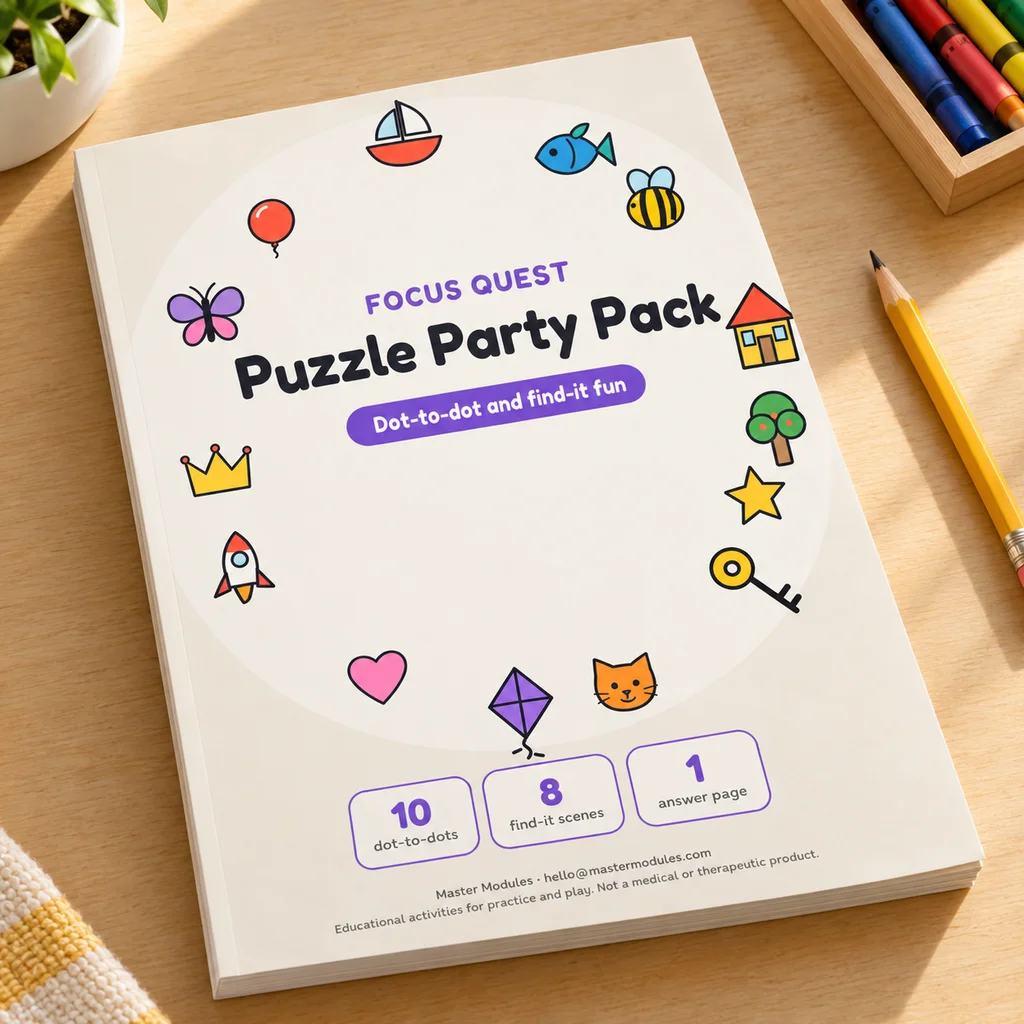
The Focus Quest Activity System includes mazes, dot-to-dots and find-and-circle pages at three levels, and the 50 Screen-Swap Cards are cut-apart cards that fit in a bag. The system also has a separate add-on, the Travel & Waiting-Room Pack, with half-letter sheets designed for this; it is sold separately and is not part of the main system.
12 quiet games to play while you wait
Games with nothing at all
1. Color Detective (ages 4 to 8). Pick a color and stay in your seat. Find 10 things of that color and point to each one, whispering its name. Easier: find 5 things. Harder: only things smaller than your hand.
2. Sound Safari (ages 3 to 8). Close your eyes for one minute and count the different sounds. Take turns guessing where each came from. Easier: name just 3 sounds. Harder: order them from nearest to farthest.
3. Shape Hunt (ages 3 to 7). Pick a shape and find objects with that shape. Tally on fingers or paper. Easier: one shape only. Harder: find shapes hiding inside bigger objects.
4. Finger Dance (ages 4 to 10). Touch your thumb to each finger, one by one, forward then backward. Keep a steady beat. Easier: one hand. Harder: both hands in opposite order.
5. Silent Charades (ages 4 to 10). Act out an animal or action without a sound. The partner guesses before you count to 20. Easier: animals only. Harder: act out a short sentence.
Games with paper and a pencil
6. Window Watch (ages 5 to 12). Look outside for two quiet minutes and list everything that moves. Easier: point and name. Harder: add how each thing moves.
7. Mystery Doodle (ages 4 to 10). One person draws a squiggle; the other turns it into a picture. Swap. Easier: start with a big shape. Harder: make the squiggle into a scene.
8. Shape Creatures (ages 4 to 9). Draw five shapes anywhere on the page, connect them into a creature and name it. Easier: three shapes. Harder: only triangles.
9. One-Line Drawing (ages 5 to 12). Draw a whole picture without lifting your pencil. Easier: scribble first, then find a picture in it. Harder: draw a face in 2 minutes.
Games with a few things on the table
10. What Changed? (ages 4 to 9). Lay out 8 small objects. One person closes their eyes while another moves or swaps one. Open and find what changed. Easier: 5 objects. Harder: change two.
11. Same and Different (ages 4 to 8). Take two similar things (two spoons or two sugar packets). Find 3 ways they are the same and 3 ways they are different. Easier: 2 of each. Harder: 5 of each.
12. Three-Word Story (ages 5 to 12). Choose three words from a menu or a book and tell a one-minute story using them all. Easier: two words. Harder: five words in order.
At a restaurant: a quick plan
Restaurants add a special problem: food takes time, and the table is full of things a child wants to touch. A simple order of play works for many families:
- Before the food arrives: a game that uses things on the table (Same and Different, What Changed?).
- While waiting for the check: paper games like Mystery Doodle or Shape Creatures.
- Keep one "emergency" page like a maze or a dot-to-dot in the bag, for when the wait doubles.
Use printed pages for longer waits
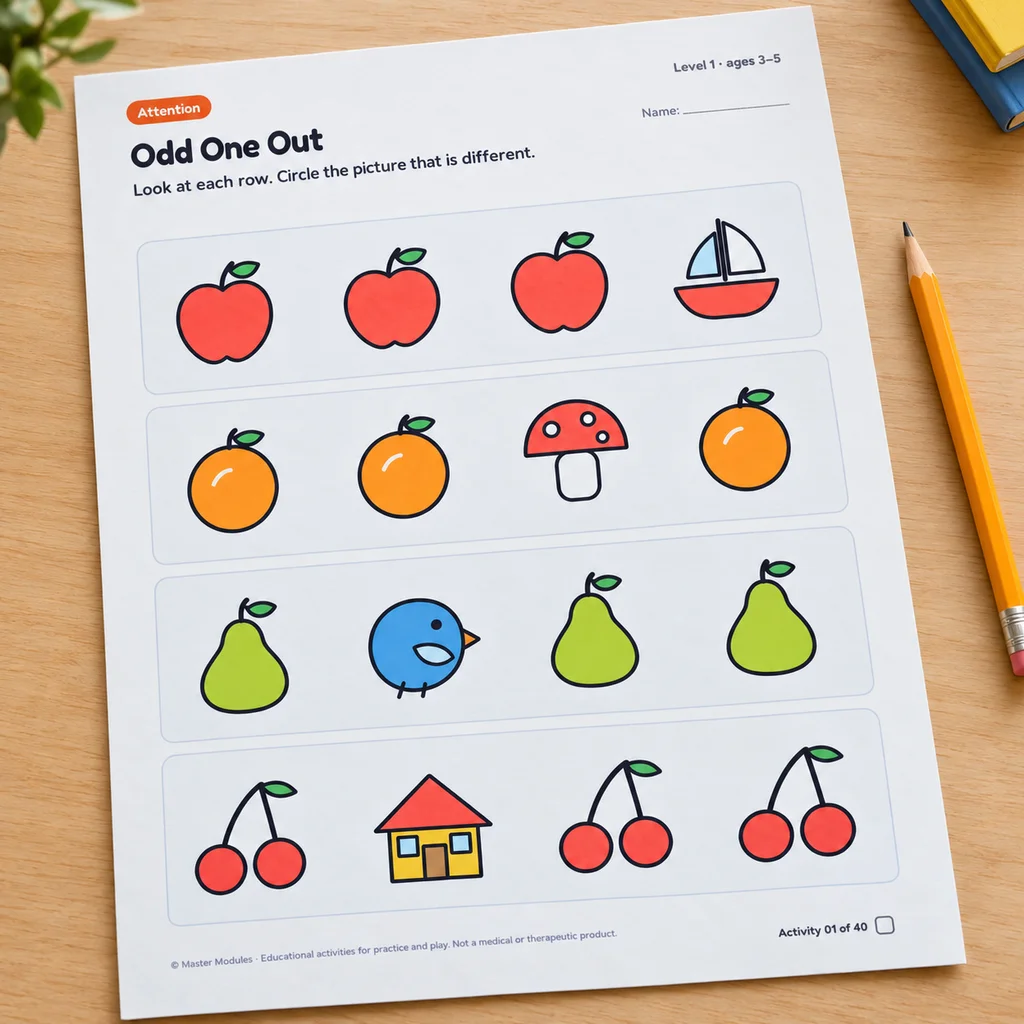
Closed, finishable pages are good for longer waits because they have a clear end. In the Focus Quest system, each level contains 6 mazes, 6 dot-to-dot pages and 3 tangle pages in its Coordination group, plus find-the-odd-one, circle-all and spot-the-differences pages in its Attention group. The Answer Key Book lets you check a maze or puzzle in seconds.
For long car trips, see printable road trip games. For a longer list organized by age, see screen-free activities by age. And if you want to reduce screen time at home, too, read how to reduce screen time without battles.
A quick checklist before you leave the house
- Pencil case packed
- Two or three printed pages
- A few game cards
- One favorite activity your child already knows how to do